


The bet that turns a win into a loss
I once watched a Cardiff side I’d backed dominate for sixty minutes, win the game, and still cost me money. They’d led 3-1 with two minutes left, the other team pulled their goalie, scored on the six-on-five, and the final whistle went at 3-2. My moneyline mates collected. I didn’t — because I’d taken the favourite on the puck line, and a one-goal win isn’t enough when you’ve handed away a goal and a half before the puck even dropped.
That game taught me more about the puck line than any guide ever did, so let me save you the tuition fee. The puck line is ice hockey’s version of a handicap, and the handicap is almost always fixed at one and a half goals. Back the favourite on the puck line and they have to win by two or more. Back the underdog and they can lose by a single goal and you still collect. It is not a bet on who wins. It is a bet on the margin of victory, and that distinction is where the format quietly punishes people who treat it like a slightly better-priced moneyline.
Why does it exist at all? Because hockey is a low-scoring sport where strong favourites are often priced at miserly odds-on prices that aren’t worth backing straight up. The handicap exists to make those favourites pay properly. Lay the favourite a goal and a half and a 1.30 moneyline shot might become a 1.85 puck-line price — far more appealing, but with a real catch attached. Across the NHL and the EIHL the standard handicap stays pinned at the same plus or minus 1.5, which makes the format consistent everywhere you’ll meet it, and once you understand it on one league you understand it on all of them.
What the puck line really is
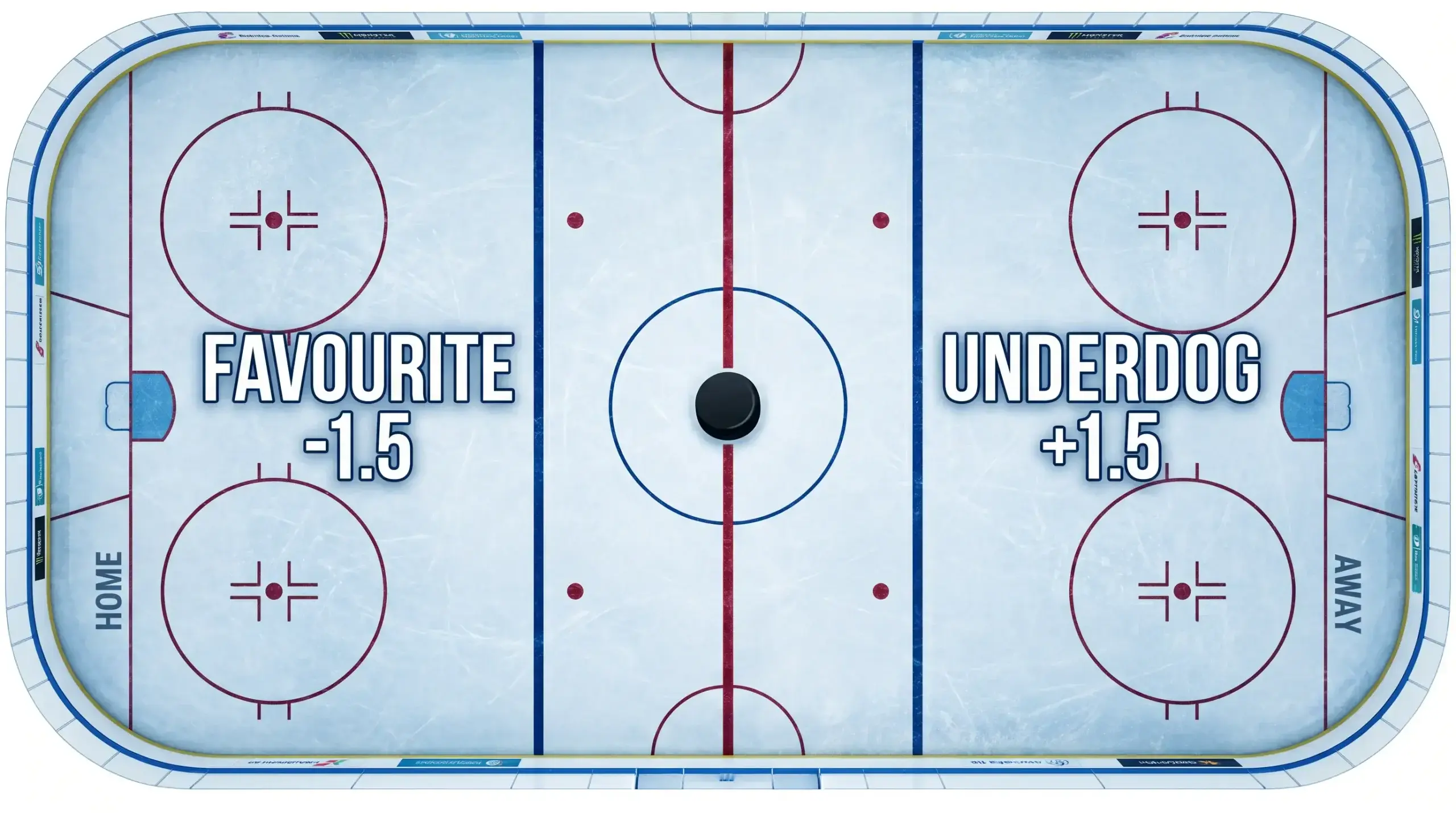
Forget the word “handicap” for a second and picture a head start. That’s all the puck line is — a virtual goal lead handed to one side before anyone laces up, designed to even out a contest the bookmaker thinks is lopsided.
The number is the thing to fix in your mind, because it almost never moves. The standard puck line in ice hockey is locked at plus or minus 1.5 goals, the same figure whether you’re looking at a Stanley Cup contender or an EIHL midweek fixture. The favourite carries the minus 1.5, meaning the bookmaker docks them a goal and a half from the final score for settling your bet. The underdog carries the plus 1.5, meaning they get a goal and a half added on. Settle a 4-2 favourite win against a minus 1.5 line and their adjusted score is 2.5 to 2 — a cover. Settle that same game against the underdog’s plus 1.5 and the dog’s adjusted score is 3.5 to 4 — a loss for them, naturally, since they conceded by two.
The half-goal is deliberate and it’s the genius of the format. There’s no such thing as half a goal, so the line can never end in a tie — every puck-line bet resolves cleanly as a win or a loss, with no pushes to refund. Compare that to handicaps in other sports that land on whole numbers and occasionally void. Hockey’s 1.5 guarantees a result, and that clean settlement is part of why the market is so popular with punters who like knowing exactly where they stand.
Here’s the mental model I use and pass on to anyone learning. Minus 1.5 is a bet that the favourite is not just better but comfortably better — good enough to win by a clear two goals. Plus 1.5 is a bet that the underdog will at least keep it close, losing by one at worst or nicking the win outright. You’re not predicting a winner. You’re predicting whether the game stays tight or breaks open, and that’s a genuinely different read of a hockey match.

What plus 1.5 and minus 1.5 actually mean for your bet
Let me put two slips side by side, because this is where the penny drops or doesn’t. Same game, two punters. One takes the home favourite at minus 1.5, the other takes the visiting underdog at plus 1.5. The game finishes 3-2 to the home side. The favourite backer loses. The underdog backer wins. Same result, opposite outcomes — and neither of them backed the team that “lost” the game on the scoreboard in a way that matched their slip.
Minus 1.5 is the demanding side. Your team has to win by two clear goals, full stop. A one-goal win — the most common margin in hockey, by a distance — settles as a loss for you even though your team won the match. Because the standard line sits at exactly 1.5, there’s no margin for sentiment: a 2-1 grind-out win is a losing puck-line ticket every single time. This is the side that lures in newcomers with its tempting price and then breaks their heart when the favourite wins ugly.
Plus 1.5 is the forgiving side, and it’s where I send most people who are new to handicaps. Your team can lose by one goal and you still collect, which in a sport where so many games are decided by a single goal is a powerful cushion. The trade-off is the price: because plus 1.5 wins so often, the odds are short, frequently odds-on. You’re paying for safety. The skill is judging when that safety is underpriced — when a plucky underdog is genuinely likely to keep it within a goal but the market has them too long on the plus 1.5.
The reason the favourite’s side is so much harder than it looks comes down to a structural feature of the sport that I cannot stress enough, and it’s the thing that turned my Cardiff night into a loss. Hockey games rarely finish with comfortable margins. A huge share of contests are decided by one goal or drift into a tense, low-margin finish, which means the minus 1.5 line is fighting against the natural shape of the game itself. You’re not just betting on the better team. You’re betting against hockey’s deep tendency to stay close.

How overtime quietly kills the minus 1.5
If there’s one rule that should be tattooed on the wrist of every puck-line bettor, it’s this one. Overtime is where the minus 1.5 goes to die, and the maths behind it is brutally simple once someone explains it.
In overtime the maximum the winning margin can grow is exactly one goal. Regulation hockey ends level, the teams play sudden-death overtime, and the first goal wins — including a goal awarded after a shootout, which counts as a single goal on the scoresheet regardless of how many attempts it took. So a minus 1.5 bet effectively loses any time the game reaches overtime, because the most the favourite can win by is the one OT goal, and one is not two. The handicap needs a two-goal margin, and overtime structurally caps the margin at one.
Sit with that for a moment, because it reframes the whole bet. When you back a favourite at minus 1.5, you are not only betting they’re better — you’re betting the game gets settled in regulation by a clear two goals. Every overtime, every shootout, every tense 1-1 game that creeps to a 2-1 OT finish is a guaranteed loss on your ticket, no matter how convincingly your team played. The favourite can be the better side for all sixty-five minutes and still bury your bet with a shootout winner.
This is the single biggest reason I treat minus 1.5 with suspicion rather than affection. The format is quietly stacked against it by the rules of the sport. Once you internalise that overtime caps the margin at a single goal, you start reading every tight game through a different lens — and you stop being surprised when a dominant favourite who can’t shake their opponent in regulation ends up burying your handicap with a shootout that, on paper, they won.
There’s a refinement worth knowing too. Some bookmakers offer the puck line on regulation time only, settling the handicap on the score after sixty minutes and ignoring overtime entirely. Others settle on the full final score including overtime and the shootout. The difference matters enormously to a minus 1.5 bet: a regulation-only line can’t be killed by an overtime cap in the same way, because a game tied after sixty simply settles the underdog’s plus 1.5. Always check which version you’re betting before you stake, because two slips that look identical can settle in opposite directions depending on that one piece of small print.

The empty-net goal that swings everything
There’s a moment in the dying minutes of a close hockey game that puck-line bettors live and die by, and it’s the one that ended my Cardiff bet. The trailing team pulls their goalie for an extra attacker, throwing six skaters at the net in a desperate push for the equaliser. Sometimes it works. Often it backfires spectacularly — the leading team wins the puck and rolls it into the gaping empty net from distance.
That empty-net goal is the puck line’s great equaliser, and the numbers behind it are striking. Roughly 20 to 25% of hockey games feature at least one empty-net goal, and the overwhelming majority of those are scored by the team already leading, padding a one-goal lead into a two-goal win in the final seconds. If you’ve backed the favourite at minus 1.5, the empty-netter is the cavalry — it converts a losing one-goal ticket into a winning two-goal cover with almost no hockey left to play. If you’ve backed the underdog at plus 1.5, it’s the assassin, turning your safe one-goal cushion into a settled loss after you’d all but collected.
I’ve learned to factor empty-net probability directly into how I read a minus 1.5 bet, and it changes the calculus more than most people appreciate. A favourite that often plays with a late lead and a trailing opponent willing to gamble is a favourite whose minus 1.5 is propped up by a real, measurable mechanism beyond just being better. Conversely, a plus 1.5 ticket that looks safe at 4-3 with a minute left is anything but, because the very situation that protects it — the trailing team chasing — is the situation that generates the empty-net goal that sinks it.
The takeaway isn’t to chase or avoid empty-net scenarios blindly. It’s to stop treating the final two minutes of a close game as a formality. For a puck-line bettor those two minutes carry a disproportionate share of the bet’s outcome, and the team most likely to score next is usually the one already in front. I’ve genuinely learned to enjoy watching the goalie-pulled scramble more than the rest of the game, because that’s the passage of play where my puck-line tickets actually get decided.

One nuance separates a sharp empty-net read from a lazy one. Not every trailing team pulls early, and not every pulled-goalie situation produces a goal at either end. A team down by one with ninety seconds left and a faceoff in the attacking zone is a very different proposition from a team down by one with twenty seconds left and the puck in their own end. The earlier the goalie comes off and the longer the favourite has to find the empty cage, the more an empty-net goal swings toward likely — and the more weight I’ll give it when sizing a minus 1.5 bet before the game even starts.
When the puck line is the right bet
After all those warnings you’d be forgiven for thinking I never touch the puck line. The opposite is true — I bet it regularly, just selectively, and the difference between a good handicap bet and a bad one usually comes down to one question I ask before every wager.
The minus 1.5 is worth taking when you have a genuine reason to expect a comfortable win, not just a win. That means a strong favourite against a weak opponent with no goaltending equaliser, a team that scores in bunches rather than grinding out one-goal results, and ideally a game where the underdog is likely to chase late and gift an empty-netter. The empty-net mechanism is so reliable that a roughly one-in-four to one-in-five chance of a late insurance goal is a quiet but real tailwind on any minus 1.5 ticket. When all three line up, the inflated price on the favourite’s handicap genuinely compensates for the two-goal demand.
The plus 1.5 is the bet I reach for when I fancy a competitive underdog but don’t trust them to win outright. Backing the dog to merely stay within a goal — or steal it in regulation — is a far more achievable proposition than backing them on the moneyline, and in a sport this prone to one-goal finishes the plus 1.5 wins often enough to be a workhorse. The catch is always the short price, so I only take it when I think the underdog’s true chance of keeping it close is higher than the odds imply. Sometimes the cleaner play is simply to weigh the handicap against the straight winner market, which is where understanding ice hockey moneyline betting pays off.
Two habits keep me honest on the puck line. First, I never take minus 1.5 on a favourite I expect to win a tight, defensive game — those are exactly the games that finish 2-1 or go to overtime and bury the bet. Second, I treat any plus 1.5 at 4-3 in the final minute as live rather than won, because the empty-net goal hasn’t happened yet. Discipline on those two points alone will save you the kind of night I had in Cardiff, and that’s worth more than any tip.

Keeping the handicap habit healthy
The puck line has a particular hook that I’d be doing you a disservice not to name. Because the favourite’s handicap pays so much better than the moneyline, it’s seductive — it dangles a proper return on a team you already fancy, and that’s a fast route to overstaking on bets that quietly need a two-goal margin to land. The bet that turns a win into a loss is also the bet that empties bankrolls fastest when it’s chased.
The UK has built real protection around exactly this kind of escalation. Stake limits arrived for online slots in 2025 — £5 for adults, £2 for those aged 18 to 24 — and while they don’t bind a hockey handicap directly, the principle behind them is the one to carry to the puck line: cap your exposure before you bet, not after a near miss. The support sector backed those measures because the warning signs are well understood, with GamCare noting it had “witnessed a steep rise in our Helpline callers citing difficulties with online slots” and welcoming the youth-focused limits as a step in preventing future harm.
So bet the puck line for what it is — a sharp, sometimes lucrative read on the margin of a game — and not as a way to juice up a favourite you’d back anyway. Set your stake before you see whether the empty-netter falls your way. Keep handicap bets a planned part of your staking, never the impulse you reach for after a one-goal win clipped your moneyline. The format rewards patience and punishes the chase, and treating it with that respect is what separates a season you enjoy from one you regret. Anyone over 18 can place these bets, but the maturity to size them properly is the bit no rule can hand you.
