


The simplest bet that still trips people up
A friend new to hockey once asked me, completely seriously, why his “win” bet had lost when the team he backed had clearly scored more goals. The answer took thirty seconds and changed how he bet forever: he’d taken the three-way line, his team had won in overtime, and on the three-way market overtime doesn’t count. He’d unknowingly bet on the wrong sixty minutes.
That’s the trap with the moneyline. It looks like the most straightforward bet in all of sport — pick the team that wins, collect if they do — and for the most part it is. The moneyline is simply a wager on the match winner with no handicap attached, no goal margin to worry about, just the result. But hockey hands you two versions of that bet wearing nearly identical clothes, and the difference between them lives entirely in how they treat overtime. Get the two confused and you’ll have nights like my friend’s, where you watch your team win and your slip lose.

Across the NHL and the EIHL the moneyline is the bet most punters cut their teeth on, and rightly so — it asks the cleanest question in betting. But “who wins?” turns out to have a hidden follow-up: “wins when?” The two-way line cares about who’s ahead when everything’s done, overtime and shootout included. The three-way line freezes the question at the end of regulation and adds the draw as a third outcome. Understanding which one you’re betting isn’t a nicety. It’s the whole game.
How the moneyline actually works
Strip away every handicap, every total, every prop, and you’re left with the moneyline — the oldest question in betting, just “who wins this?” That purity is exactly why it’s the right place for a beginner to start and why even sharp bettors keep coming back to it.
You pick a side, the bookmaker gives you a price, and if your team wins you collect at that price. The favourite carries the shorter odds because they’re more likely to win; the underdog carries the longer odds because they’re not. In the UK you’ll see these prices in fractional or decimal, and decimal makes the relationship cleanest — a 1.50 favourite returns £1.50 on a pound including your stake, while a 3.00 underdog returns three. That total-return-on-one-unit logic is precisely why I’d steer any newcomer toward decimal odds before they ever place a moneyline bet, because the price tells you the payout without a scrap of arithmetic.
What makes the hockey moneyline distinct from, say, football is the scoring environment. Hockey is low-scoring and tight, which compresses the odds — true blowouts are rare, so even strong favourites are often priced shorter than their quality alone would suggest, and underdogs win outright far more often than newcomers expect. That tightness is the moneyline’s great gift to the value-hunter: because so many games are genuine coin-flips that the market prices as coin-flips, the edge goes to whoever reads the matchup better than the odds do.
There’s a vocabulary that comes with the territory and it’s worth getting comfortable with early. A short-priced favourite, especially one below evens, is “odds-on” — the bet pays you less than you stake because the win is judged more likely than not. A long-priced team is the “outsider.” The line you’ll bet by default, the one that settles on the full result, is sometimes called the “full-time” or all-inclusive line to distinguish it from the regulation-only version. Knowing those terms isn’t pedantry; it’s how you avoid betting the wrong market by accident.
One more feature of the hockey moneyline catches people out, and it’s the timing. Because the sport runs on a relentless schedule with games most nights of the week, prices move constantly right up to the face-off, driven by news that has nothing to do with the teams’ underlying quality. A confirmed starting goaltender, a late scratch, a back-to-back fixture that leaves one side tired — any of these can shift a moneyline price in the hours before puck drop. The lesson is that the price you see in the morning isn’t the price you’ll get at night, and on the moneyline more than most markets, when you bet can matter as much as what you bet.

Two-way versus three-way: the distinction that decides your bet
Picture the exact same game settled two different ways. Two-way line: only two outcomes exist, home win or away win, and the bet runs until someone’s actually won — through overtime, through a shootout if it comes to that. Three-way line: three outcomes, home win, away win, or draw, and the clock stops dead at the end of regulation. Same game, same teams, completely different bets. This is the fork in the road that catches more newcomers than any other single thing in hockey betting.
The two-way moneyline is the one most UK punters mean when they say “moneyline,” and it’s the more forgiving of the two. Because it settles on the full result, there’s no draw to worry about — somebody has to win the match eventually, even if it takes a shootout, and your bet rides along until they do. Crucially, overtime and the shootout count. If your team is level after sixty minutes and wins in the extra session, your two-way bet wins. The maximum a winning margin can grow in overtime is a single goal, including a shootout decider that counts as one goal, but on the two-way line the margin is irrelevant — all that matters is who’s standing at the end.
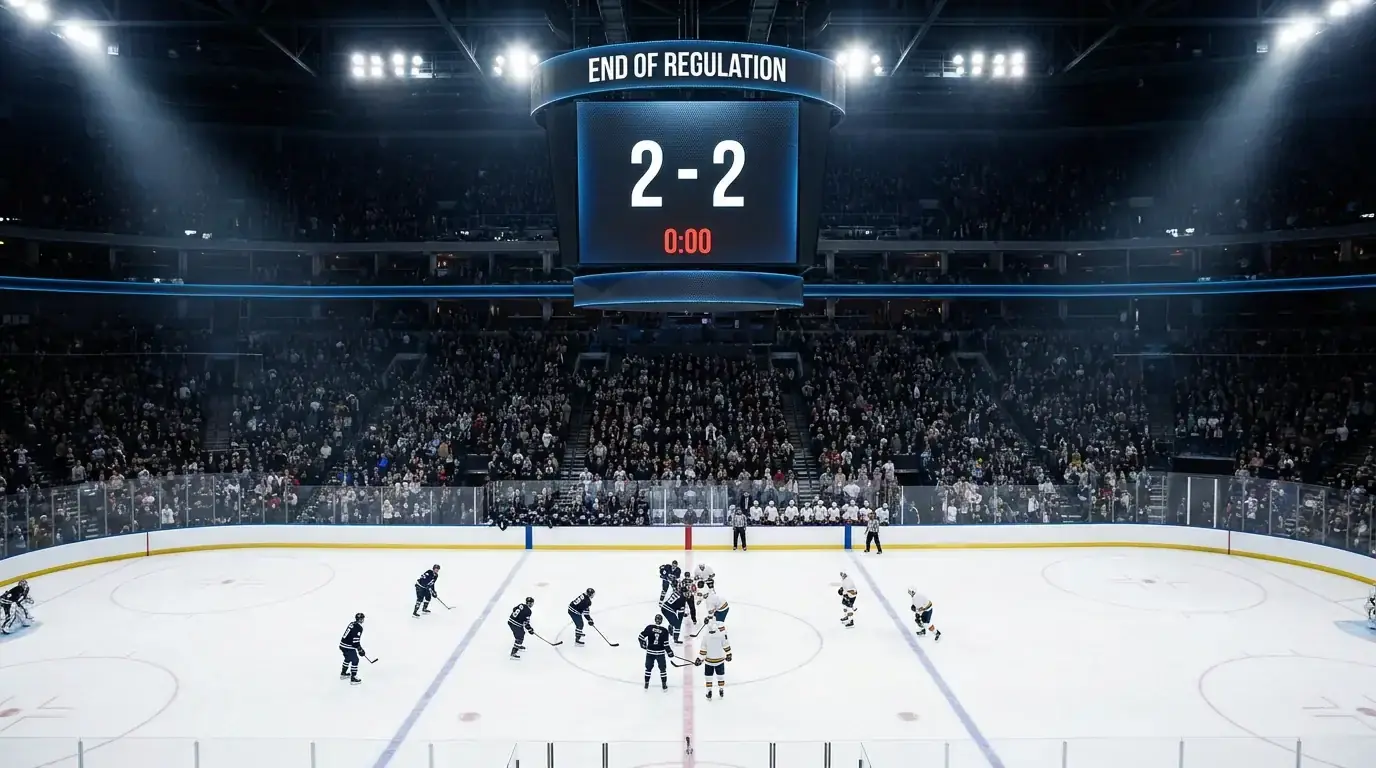
The three-way moneyline, by contrast, treats regulation time as the whole universe. It only counts the score after sixty minutes, which is why the draw exists as a third option: plenty of hockey games are level at the end of regulation before overtime decides them. Bet a team on the three-way line and they must win in those sixty minutes for you to collect — if the game is tied at the buzzer and your side wins in overtime, your three-way bet has already lost, settled the instant regulation ended. That’s the precise trap my friend fell into, and it’s a costly one because the three-way prices look more generous, which is exactly what tempts people in.
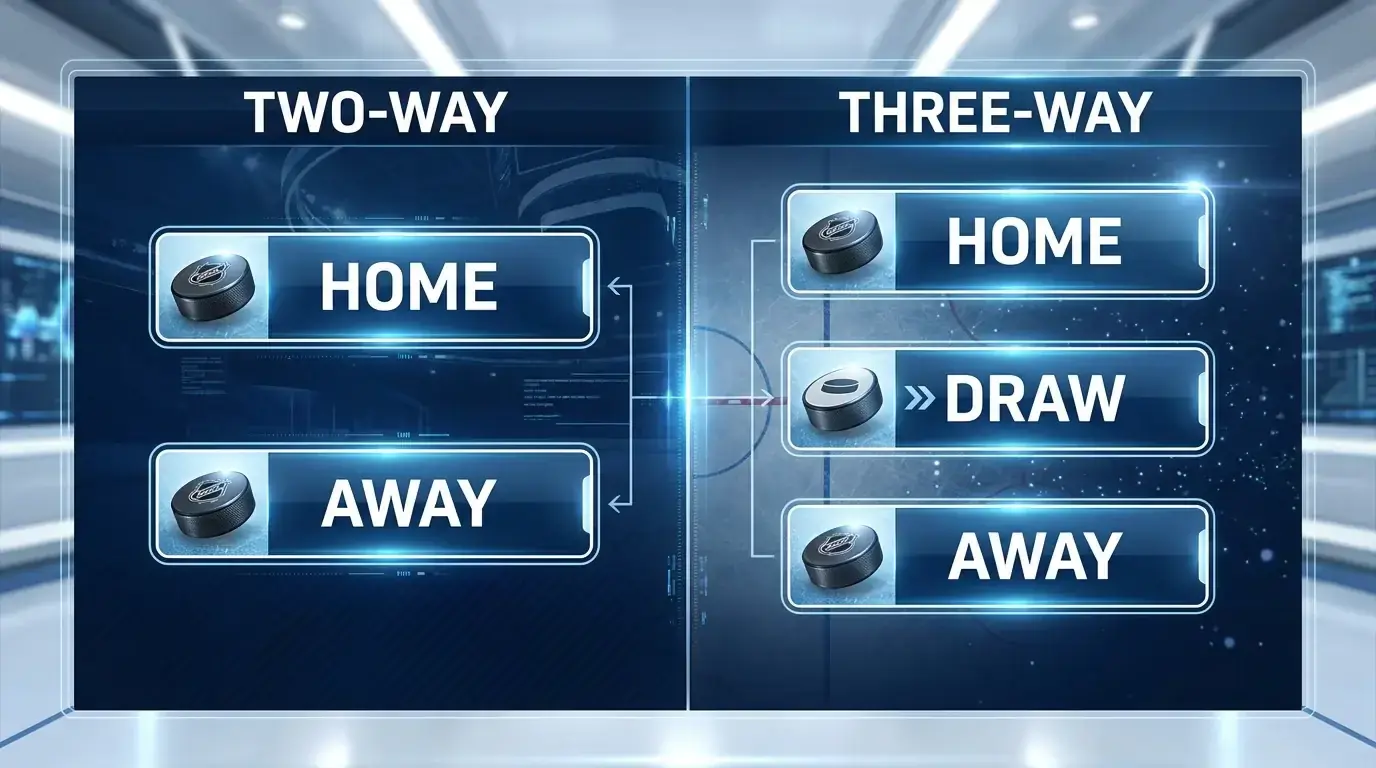
Why does the three-way pay better? Because each outcome is less likely once you carve out the draw as its own result, so the odds on a straight win lengthen. You’re being paid more because you’re being asked to do more — win inside regulation, not just win. I use the three-way deliberately when I think a game will be settled in sixty minutes and want the bigger price, and I avoid it like the plague when I fancy a team but expect a tight, overtime-bound contest. Choosing between them is a read on the shape of the game as much as the winner.
Living with the draw
The draw is the outcome that makes hockey’s three-way market feel alien to anyone raised on football, where a draw is a perfectly ordinary result. In hockey, the draw only exists at the regulation buzzer — there are no tied final scores, because overtime and the shootout guarantee a winner. So the “draw” on a three-way line is really a bet on a specific, temporary state: level after sixty minutes, before the game gets decided.
That makes the draw a genuinely interesting wager once you understand what you’re actually betting on. You’re not betting that the game ends in a tie — it can’t. You’re betting that neither side leads when regulation expires, which happens more often than casual fans realise because hockey’s late stages are so frequently locked at one goal apart or dead level. A 2-2 game heading into the final minute is a live draw ticket even though everyone knows someone will win in overtime. The draw price reflects how likely that knife-edge regulation finish is, and on evenly matched teams it can be a meaty number.
There’s a close cousin of the three-way worth knowing: draw no bet. On a draw-no-bet market you back a team to win in regulation, and if the game is level at sixty minutes your stake is simply returned rather than lost. It’s a safety valve — you sacrifice some of the price in exchange for getting your money back on a regulation tie. I reach for it when I’m confident a team is the better side but genuinely unsure whether they’ll break a stubborn opponent inside sixty. It won’t make you rich, but it takes the sting out of the most common way a three-way win bet dies.
The one habit I’d press on anyone exploring the draw market: always confirm whether overtime or the shootout factors into settlement, because the answer is the difference between a returned stake and a lost one. The deeper mechanics of how a regulation tie settles, and exactly when draw no bet beats a straight three-way, deserve a proper look, and the principle holds whichever league you’re betting.
Let me show why the draw is more than a curiosity with a quick worked example. Two evenly matched sides might be priced something like 2.40 each to win in regulation, with the draw at 3.80. Convert those to implied chances — roughly 42%, 42% and 26% — and you’ll notice they total well over a hundred, which is the bookmaker’s margin doing its quiet work. But the interesting figure is that 26%: better than one game in four between closely matched teams ends regulation level. If your read of a defensive, low-event matchup says the true chance of a stalemate is closer to a third, the draw at 3.80 is a value bet hiding behind a market most punters never even look at. That’s the kind of overlooked corner where the three-way line genuinely rewards the bettor who does the homework.
Reading favourites and outsiders
The most expensive mistake I see on the moneyline isn’t picking the wrong team — it’s paying the wrong price for the right one. A favourite can be a brilliant pick at one price and a terrible bet at another, and learning to feel that difference is what turns a fan into a bettor.
“Odds-on” is the word for a favourite priced below evens, where you stake more than you’d win in profit — a 1.40 shot, for instance, pays just forty pence on the pound. Hockey produces a lot of these because the sport’s best teams genuinely win most nights, but the tight scoring means even dominant sides lose more often than their short prices suggest. That’s the tension at the heart of moneyline value: the favourite is usually right, but “usually” gets priced as “almost always,” and the gap is where the underdog backer makes a living.
The EIHL is a useful laboratory for this, because its title contenders are strong but its games stay competitive. The league’s three perennial heavyweights convert somewhere between 60 and 65% of their home games into wins, and their match prices against mid-table opposition typically sit in the decimal 1.60 to 1.90 range. Do the arithmetic and a 1.70 price implies a roughly 59% chance — yet these sides win closer to two-thirds at home, which tells you the home favourite is often a touch underpriced rather than overpriced. That kind of structural read, where the data quietly disagrees with the market, is exactly what the moneyline rewards.

The outsider side of the ledger is where patience pays. Backing underdogs blindly is a slow way to lose money, but hockey’s tightness means genuine longshots win often enough that a disciplined outsider bettor — one who picks spots where a hot goalie or a tired favourite skews the true odds — can find real value at prices the market has stretched too far. The home-ice numbers cut both ways: if the favourites are taking two-thirds of their home games, they’re dropping the other third, and an underdog at a generous price in one of those games is precisely the bet the moneyline exists to reward.
None of this works without the value lens, and the value lens is just implied probability turned into a habit. Convert every price to a percentage, compare it to your honest read of the game, and bet only when your number beats the market’s. It sounds clinical, but it’s the difference between betting on teams you like and betting on prices that are wrong — and only one of those makes money over a season.
I’ll give you the mental sequence I run for every moneyline pick, because it’s quicker than it sounds. First, what’s the price as a percentage? Second, what do I genuinely think the chance is, ignoring the price entirely? Third, is my number bigger? Only if the answer to the third is yes does the bet go on. The discipline is in being honest at step two — it’s terribly easy to nudge your own estimate upward to justify a bet you’ve already decided you want. A favourite at 1.70 implying 59% is a pass if I think they’re a 55% side and a strong bet if I think they’re a 68% side, and the team is identical in both cases. The price is the bet, not the badge.

Turning the moneyline into a strategy
After nine years I’ve boiled my moneyline approach down to a handful of rules that have nothing to do with picking winners and everything to do with picking prices. The teams are the easy part. The discipline is the edge.
Rule one: match the market to the game. If I expect a tight, possibly overtime-bound contest, I take the two-way line so a late winner still pays me. If I expect a decisive result inside sixty minutes, I take the three-way for the better price — and I accept that an overtime finish kills it. Choosing the wrong market for the game I expect is a self-inflicted loss, and it’s the one I’m most ruthless about avoiding.
Rule two: respect home ice without worshipping it. Strong home favourites in the EIHL winning 60 to 65% of the time is a real edge, but it’s already partly in the price, so I only lean on it when the line hasn’t fully accounted for it. The EIHL’s home advantage is strong enough to anchor a strategy around, and I’ve gone deeper into where it pays and where it’s a trap in EIHL betting odds — the home-ice read is one of the most reliable angles the league offers.
Rule three, and the one that matters most for the long haul: bet within limits you set in advance. The moneyline’s simplicity is seductive — it’s easy to talk yourself into “just one more” on a team you fancy — and that’s exactly the slope the UK’s tighter gambling rules are designed to flatten. The push for a public-health approach to gambling harm has been a long time coming, and as one charity statement put it, the sector has long argued that gambling harm “is a serious public health issue which can affect millions of people each year.” I treat that as the backdrop to every bet: the simplest wager in hockey is also the easiest to overdo, and the only defence is deciding your stakes before the puck drops, never after. Anyone over 18 can place these bets, but only a disciplined bettor keeps doing it without regret.
