


How to Read Hockey Betting Lines: NHL & EIHL Odds Explained
The first time a mate asked me to "just explain the hockey betting lines" over a pint, I made the mistake of assuming he meant the right sport. He'd been clicking around a bookmaker's site looking for ice hockey and kept landing on women's field hockey fixtures, wondering why nobody was offering a puck line. That confusion is the most British thing about this whole subject. In the UK, "hockey" means the game played with sticks on grass. The sport you actually want to bet on — the one with the rink, the goalies, the empty-net drama — lives under the heading ice hockey betting, and if you don't know that, you'll spend ten minutes lost before you've even seen a price.
So let me set the record straight from the first line. A hockey betting line is nothing more mystical than a short string of numbers that answers three questions: who's favoured, by how much, and how many goals the bookmaker expects. Strip away the jargon and every market you'll ever see is built from those three ideas — a price, a handicap, and a total. Once you can read those numbers, the whole board opens up, whether you're looking at an overnight NHL slate from North America or a Saturday night Elite Ice Hockey League clash in Belfast or Cardiff.
I've spent the better part of nine years reading these lines for a living, mostly across the NHL and our own EIHL, and the thing I've learned is that the maths is the easy part. The hard part is the context the bookmaker doesn't print on the slip: how overtime quietly destroys a handicap bet, why an empty-net goal in the last minute can flip a result you'd already counted as won, and how a starting goalie's name moves a price more than any other single factor. This guide walks through all of it in plain British English, in the fractional and decimal formats you'll actually see on UK sites, with payouts in pounds rather than dollars.
There's real money flowing through this market, too. The regulated gambling industry in Great Britain reached a gross gambling yield of 16.8 billion pounds in the year to the end of March 2025, growing more than seven per cent year on year, and a sizeable slice of that runs through online sports betting. That scale is exactly why bookmakers price hockey carefully and why a punter who can actually read a line has a genuine edge over one who can't. By the time you finish reading, you'll be the second kind.
The Short Version Before You Stake
- Every hockey line is three numbers: a price (who's favoured), a puck line handicap fixed at plus or minus 1.5 goals, and a goals total that usually sits around 5.5 to 6.5.
- UK sites show prices as fractional like 5/1 or decimal like 2.50 — learn to read both, because confusing return with profit is the quickest way to misjudge a payout.
- Overtime can only ever add one goal, so a minus 1.5 favourite almost always loses the handicap once a game goes past 60 minutes.
- You can bet the EIHL alongside the NHL in Britain; our domestic league drew an average of 3,863 fans a game in 2025-26, and its prices behave differently from North America's.
- All licensed UK betting runs under the Gambling Commission, with stake limits and a new statutory levy now shaping the market — check the licence before you stake.
What a Hockey Betting Line Actually Tells You
Picture the betting board the way a chef looks at a kitchen pass: a lot of plates, but only three recipes underneath them all. I tell every beginner the same thing — once you see that the dozens of markets on a hockey fixture are reshuffled versions of three core ideas, the intimidation drains out of it. There is no fourth secret market the sharps know about that you don't.
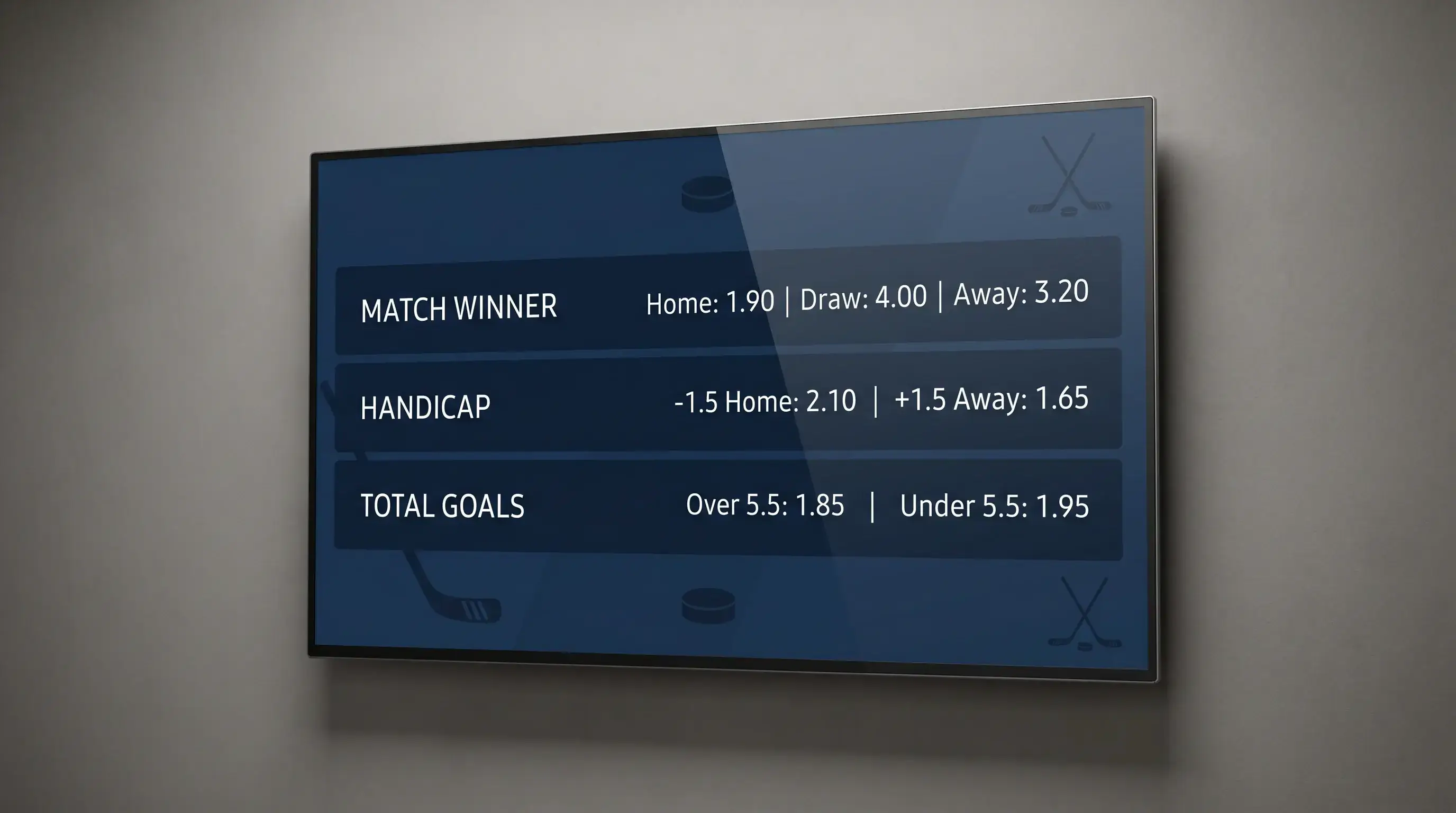
The first idea is the price, which simply tells you who the bookmaker thinks will win and how much they'll pay you if you back the right side. The second is the handicap, a head start or deficit applied to the score so that a one-sided fixture still offers an interesting bet. In ice hockey that handicap has a name — the puck line — and it is almost always fixed at plus or minus 1.5 goals rather than floating about like a points spread in basketball. The third idea is the total, the bookmaker's estimate of combined goals, where you bet whether the real game finishes above or below the posted number. A typical ice hockey total lands somewhere between 5.5 and 6.5 goals, which tells you straight away this is a lower-scoring sport than the football scorelines might suggest by comparison.
Everything else on the slip is a variation. In-play markets are these same three ideas, repriced second by second as the game unfolds. Accumulators staple several of them together. Player props zoom in on one skater instead of the team. But the spine never changes: price, handicap, total. If you can name which of the three you're looking at, you already understand the bet better than most people clicking the button next to it.
Puck line — the ice hockey handicap, fixed at plus or minus 1.5 goals, used to level out a mismatch between favourite and underdog.
Here's the mental discipline I'd ask you to build early. Before you ever think about whether a bet is good value, work out which of the three numbers you're actually being offered, and in which format the price is written. A surprising amount of money is lost not to bad judgement but to people backing a handicap when they thought they were backing a straight winner, or reading a decimal price as if it were fractional. The numbers are honest. The mistakes are almost always in the reading.
A quick orientation before the detail: moneyline means you're picking the outright winner with no handicap. Puck line means you've taken the plus or minus 1.5 handicap and need your side to cover it. Totals mean you've ignored who wins entirely and bet on the combined goal count. Three doors, and the rest of this guide opens each one in turn.
The reason it pays to nail this foundation is that ice hockey punishes lazy reading more than most sports. A football match can drift to a quiet 1-0 and your handicap survives. Hockey's late goals, its pulled-goalie chaos and its overtime quirks mean the difference between the moneyline and the puck line is rarely academic — it decides winning slips and losing ones on the same final score. So treat the next few sections as building blocks. We'll take each of the three ideas, show you exactly how it reads in fractional and decimal, and then put them together on a real-looking line.
Fractional or Decimal: The Same Price in Two Languages
I once watched a friend celebrate a winning bet, do the sums in his head, and then look genuinely deflated when the cash hit his account. He'd backed something at 5/1 and expected six times his money back. The bookmaker had paid him exactly what he was owed — he'd just confused profit with total return, which is the single most common reading error in this whole business. Sort that one out and you've already saved yourself more than this guide is worth.
Fractional and decimal are not two different prices. They are the same price written in two languages, the way a temperature can read as 20 in Celsius or 68 in Fahrenheit without the weather changing. Fractional odds — the traditional British style, written 5/1 or 5/6 — tell you profit relative to stake. Decimal odds, increasingly the default on UK sites, tell you the total return per pound including your stake back.
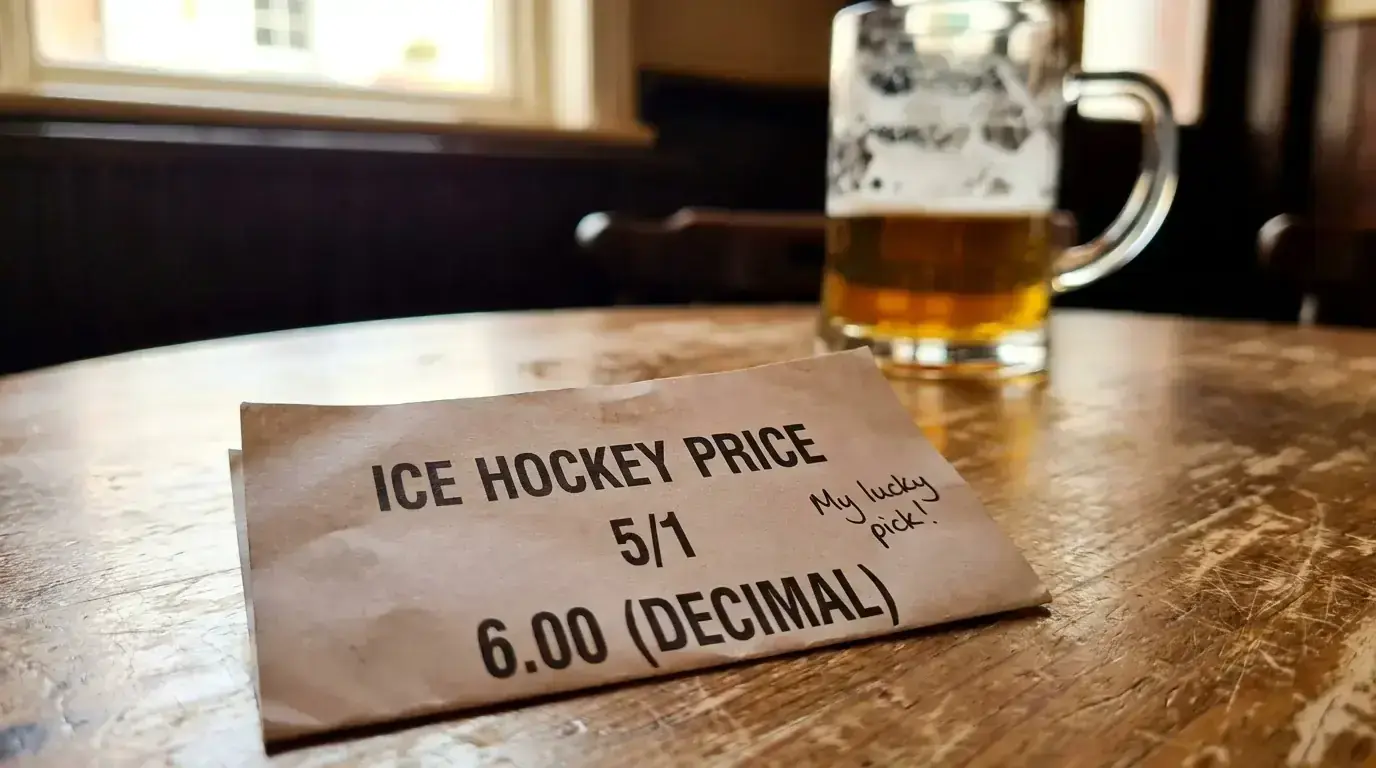
Fractional, odds-against: 5/1
The number on the left is what you win, the number on the right is what you stake to win it. So 5/1 means a 1 pound stake returns 5 pounds profit plus your original 1 pound back — 6 pounds total in your hand.
Fractional, odds-on: 5/6
When the left number is smaller than the right, the selection is odds-on, meaning a strong favourite. Here a successful 6 pound stake returns 5 pounds profit plus the 6 pounds back, so 11 pounds total. You're risking more than you stand to win, which is the price you pay for backing something likely.
That odds-on case trips people up, so sit with it for a second. A 5/6 favourite is not a bad bet by definition — it's just one where the bookmaker rates the outcome more likely than not, and pays accordingly. Plenty of hockey moneylines on a heavy favourite live in exactly this territory.
Decimal is, frankly, easier for newcomers, and I steer most beginners towards it. The number is the total return on a 1.00 stake, full stop. A decimal price of 3.00 means a 1 pound stake returns 3 pounds in total — that's 2 pounds profit plus your 1 pound back. There's no left-and-right to untangle, no odds-on confusion, just one figure you multiply by your stake. The trade-off is that decimal hides the "shape" of a price that experienced fractional readers feel instinctively, but for getting the payout right, decimal wins on clarity every time.
Converting between the two
To turn fractional into decimal, divide the fraction and add one: 5/1 becomes 5 + 1 = 6.00, and 5/6 becomes 0.83 + 1 = 1.83. To find the implied probability — the chance the price suggests — divide 1 by the decimal: 1 / 6.00 is about 17 per cent, while 1 / 1.83 is about 55 per cent. That probability figure is the one number that tells you whether a price is generous or mean.
Why does implied probability matter so much? Because a bookmaker's prices on a single game always add up to more than 100 per cent. That extra slice is the overround, the built-in margin, and it's how the firm makes money whoever wins. Online gambling yield in the UK grew more than 13 per cent to 7.8 billion pounds in the most recent figures, and that margin is a meaningful part of where it comes from. Knowing how to strip a price back to its implied probability is what separates a punter who shops for value from one who just clicks the biggest number.
This is the foundation everything else rests on, and it deserves more room than a pillar section can give it. If you want the full conversion drills, the implied-probability worked examples and a proper breakdown of the overround, I've put it all in the dedicated guide to fractional versus decimal odds for UK punters. For now, hold onto two things: fractional shows profit, decimal shows total return, and they never disagree about the underlying price.
The Moneyline: Backing a Winner, Pure and Simple
If betting were a pub quiz, the moneyline would be the round where the question is simply "who won?" No handicaps, no goal counts, no asterisks — just pick the team that finishes ahead and collect. It's the bet I'd point any newcomer to first, because there's nothing to misread except the price itself.

The moneyline is a wager on the match winner. Back a side, and if they win the game, your bet wins. The only subtlety worth knowing up front is how it handles a game that's level after 60 minutes, and this is where ice hockey differs from football. In the standard two-way moneyline you'll see on most UK sites, overtime and the shootout count: whoever wins in extra time wins your bet. The favourite is priced odds-on, often in that 5/6 region, and the underdog drifts longer to reflect their slimmer chance.
A sample moneyline
Allow me a brandless illustration. Suppose a road favourite is priced at 4/6 fractional, which is 1.67 decimal. A 10 pound stake returns 16.67 pounds in total — about 6.67 pounds profit. The underdog might sit at 6/4, or 2.50 decimal, where the same 10 pounds returns 25 pounds. The gap between those two prices is the bookmaker telling you, in money, how likely they think each result is.
Here's the part that catches people out, and it's the same quirk that haunts the puck line. Because ice hockey can only ever finish one goal apart in overtime — sudden death stops the moment someone scores, and a shootout counts as a single deciding goal — the moneyline and the handicap behave very differently when a game goes the distance. On the moneyline that overtime winner is gold; your team won, you're paid. The complications only arrive when a handicap is attached, which is the next section's business.
There's also a three-way moneyline, common on European sites, where the draw at the end of regulation time is a separate outcome alongside the home win and away win. Bet the home side on a three-way line and a game that goes to overtime settles as a draw — your home-win bet loses even though they eventually won. It's a genuinely different market with its own logic, not just a cosmetic variation.
That distinction between two-way and three-way settlement is exactly the kind of thing that separates a confident bettor from a confused one, and it deserves a fuller treatment than I can give it here. The mechanics of when the draw settles, how odds-on favourites read, and how to think about strategy across both formats are laid out in my guide to ice hockey moneyline betting and the three-way draw market. For the pillar, take away this: the moneyline is the cleanest bet on the board, overtime helps you on a two-way line, and the only thing you really need to master is reading the price.
The Puck Line: Where the Handicap Earns Its Keep
The puck line is where I've watched the most punters snatch defeat from the jaws of victory, and almost always for the same reason. They back a strong favourite at a juicy price, the favourite duly wins, and the bet still loses — because the game went to overtime and the handicap they'd taken needed a two-goal cushion that overtime makes impossible. Understand that one trap and the puck line goes from a wallet-emptier to one of the most useful tools on the board.

The puck line is ice hockey's handicap, and unlike the floating spreads in other sports it's locked at plus or minus 1.5 goals. The favourite is offered at minus 1.5, meaning they must win by two clear goals for your bet to land. The underdog is offered at plus 1.5, meaning they can lose by a single goal and your bet still wins. That fixed 1.5 is the whole game: it turns a lopsided fixture, where the favourite's moneyline is too short to bother with, into a more balanced and better-paying proposition.
Reading a puck line
Pure illustration, no brand attached. Say the home favourite is minus 1.5 at 6/4 fractional, or 2.50 decimal. A 10 pound stake returns 25 pounds in total if — and only if — they win by two or more goals. The visiting underdog at plus 1.5 might be 8/13, around 1.62 decimal, where 10 pounds returns roughly 16.20 pounds for them simply staying within one goal or winning outright. Notice the favourite pays more on the puck line than they would on the moneyline: that's your reward for taking on the two-goal requirement.
The overtime trap, stated plainly: in extra time the score can rise by a maximum of one goal, because sudden death ends the instant anyone scores and a shootout is recorded as a single deciding goal. A team that wins in overtime therefore wins by exactly one. So a minus 1.5 favourite loses the puck line the moment a game slips past 60 minutes, no matter how dominant they looked. If you back a favourite to cover, you are also betting against overtime whether you meant to or not.
The flip side of that coin is the empty-net goal, and this is the detail that separates people who've watched a lot of hockey from people who've only read about it. When a team is trailing late, they pull their goalie for an extra attacker, gambling everything on an equaliser. It often backfires: the leading side fires into the unguarded net and the one-goal game suddenly becomes a two-goal game in the final seconds.

Roughly 20 to 25 per cent of games feature at least one empty-net goal, and the team already leading scores the overwhelming majority of them. That late insurance marker is precisely what rescues a minus 1.5 favourite or sinks a plus 1.5 underdog who looked safe with thirty seconds to play.
Put those two forces together and you can see why the puck line rewards thought. Overtime is the enemy of the minus 1.5 backer; the empty-net goal is their friend. Read a fixture for how likely it is to stay tight into the third period, and you're reading the puck line properly. The full scenario-by-scenario breakdown — when to take the favourite, when the plus 1.5 underdog is the value play, and what a backdoor cover actually means — lives in my detailed guide to puck line betting and ice hockey handicaps. The headline for now: minus 1.5 needs two goals and fears overtime, plus 1.5 forgives a narrow loss, and the empty net decides more of these than anyone expects.
Interactive tool
Hockey line settler
Enter one final score and see how all three lines settle — moneyline, puck line and total — at the same time. Toggle overtime and add an empty-net goal to watch the puck line flip. Same score, three different results.
- Return on your bet £0.00
- Final result Home by 1
- Combined goals 5 · Under 5.5
Over/Under: Betting the Scoreboard, Not the Winner
Some nights you can read a fixture inside out and still have no idea who'll win — two evenly matched sides, both capable, a genuine coin flip. Those are the nights I stop trying to pick a winner and start asking a different question entirely: how many goals will these two actually score between them? That's the totals market, and it's the one bet on the board that doesn't care who wins at all.
A total, or over/under, is the bookmaker's posted number for combined goals in a game. You bet whether the real total finishes above or below it. In ice hockey that number typically sits between 5.5 and 6.5 goals — the half-goal exists deliberately so there can be no tie on the bet itself. If the line is 5.5 and the game finishes 4-2 for six goals, the over wins; finish 3-2 for five and the under takes it.

A totals line in practice
Brandless example. Suppose the total is set at 5.5 goals, with the over at 10/11 fractional, roughly 1.91 decimal, and the under at the same kind of price. A 10 pound stake on the over returns about 19.10 pounds if six or more goals are scored. The near-even pricing on both sides tells you the bookmaker genuinely isn't sure which way it'll break, which is usually a sign of a well-set number.
What moves that number? Two things above all: pace and goaltending. Two high-tempo attacking teams with shaky netminders push the total up; a pair of defensive sides with elite goalies drag it down. The starting goalie matters enormously here — a confirmed number-one between the pipes versus a back-up making a rare start can shift the expected goals by a goal or more, which is a lifetime in a market priced to the half-goal.
One quirk worth banking: overtime and shootout goals usually do count towards the total on most UK sites, unlike the way overtime caps the puck line. A game tied 2-2 that's settled by an overtime winner counts as five goals for totals purposes. Always confirm the rule on the slip, because a single goal either side of the line is the whole bet.
I treat totals as a thinking person's market because the public tends to lean over — backing goals is more fun than backing a goalless grind — which can leave value on the under when a game looks likely to tighten up. Read the goaltending matchup before you read anything else, watch for confirmed starters rather than projected ones, and remember that a single late empty-net goal can carry an under-looking game over the line. Totals reward patience and a feel for tempo more than they reward backing the bigger name.
Futures and Outrights: The Long Game
There's a particular kind of patience that futures betting demands, and I learned it the hard way by backing a Stanley Cup outsider in October and then watching the price drift further out for two months while I quietly questioned my own judgement. Futures aren't a single-night thrill. They're a slow burn, where your stake is tied up for weeks or months and the payoff — when it comes — is a season's worth of being right.

A future, or outright, is a bet on a season-long result rather than a single game: who lifts the trophy, who tops the table, who finishes as leading scorer. Because the field is large and the timeframe long, the prices are generous compared with a single match. In the NHL that means Stanley Cup outrights at long decimal prices; in our own EIHL it means league, playoff and Challenge Cup markets. The 2025-26 EIHL season ended with Belfast Giants taking the regular-season title — their eighth — Nottingham Panthers winning the Challenge Cup and Cardiff Devils lifting the playoff crown, exactly the kind of three-trophy split that keeps several outright markets live deep into a season.
| Feature | NHL Stanley Cup futures | EIHL outright markets |
|---|---|---|
| Field size | Large, 30-plus teams | Compact, 10 teams in 2025-26 |
| Typical title price | Long, often double-figure decimals on contenders | Top clubs around decimal 3.50 to 5.00 |
| Markets offered | Stanley Cup, conference, division, scoring titles | League, playoff, Challenge Cup, top scorer |
| Price stability | Drifts heavily over a long season | Tightens fast given the smaller field |
The contrast in that table is the whole point. A handful of EIHL clubs — Sheffield Steelers, Belfast Giants, Cardiff Devils among them — sit at championship prices in that decimal 3.50 to 5.00 band, which is short by NHL standards because there are simply fewer teams capable of winning. With ten sides rather than thirty-plus, the favourites are closer together and the value is harder to find but easier to judge.
My rule with futures is simple: only stake what you're happy to have locked away for the duration, and treat early-season prices as the place value lives, before the market has watched enough hockey to be sure. The deeper read on outright pricing, home edge and where the EIHL title value actually sits is in my guide to EIHL betting odds and the Elite Ice Hockey League.
NHL and EIHL: Two Leagues, Two Betting Climates
People assume that because both leagues play the same sport, you bet them the same way. You don't. Backing the NHL from a sofa in Manchester and backing the EIHL from a seat in the Motorpoint Arena are two genuinely different disciplines, and the punters who do best are the ones who respect the gap rather than paper over it.

The NHL is the deep, liquid, heavily modelled market — vast amounts of data, every bookmaker pricing it, lines that move fast on goalie news and sharp money. The EIHL is our home league, smaller and less efficiently priced, where local knowledge counts for more and the bookmakers don't have the same army of models behind every number. That inefficiency is opportunity, but only if you actually watch the league rather than guessing at it.
Average EIHL attendance
3,863 per game in 2025-26, up from 3,660 the previous season and 3,148 in 2022-23 — a league growing its live audience year on year.
Championship price band
Top EIHL clubs sit around decimal 3.50 to 5.00 for the title, short by NHL standards because the field is just ten teams.
Home win rate, top sides
The leading EIHL favourites convert 60 to 65 per cent of home games into wins, with Cardiff Devils' home rate frequently topping 70 per cent.
Match odds, favourites at home
Against mid-table opposition those favourites are typically priced decimal 1.60 to 1.90 — odds-on, but with the home edge baked in.
That home advantage is the EIHL's defining betting feature and it's far stronger than what you'll find in the NHL. When a top side converts close to two-thirds of its home fixtures and a club like Cardiff pushes past 70 per cent at home, the home favourite is a structural fact of the league rather than a fluke of form. North American hockey doesn't hand you anything that reliable, partly because the travel and scheduling grind levels everyone out over an 82-game marathon.
| Factor | NHL | EIHL |
|---|---|---|
| Market depth | Very deep, every market priced | Thinner, fewer props and specials |
| Pricing efficiency | Sharp, fast-moving lines | Softer, rewards local knowledge |
| Home advantage | Modest over a long season | Strong, 60 to 70 per cent for top sides |
| Schedule fit for UK | Late-night puck drops | UK-friendly evening and weekend slots |
The practical upshot is that these leagues suit different habits. The EIHL fits naturally into a UK evening and rewards the fan who knows which rink is a fortress; the NHL offers depth and liquidity but asks you to be awake at odd hours and to compete with sharper prices. Neither is "better" to bet — they're different tools. The full UK-angled breakdown of NHL markets, futures and the time-zone juggling act is in my guide to NHL odds for UK bettors, and the home-edge numbers above get their proper workout on the EIHL side.
Where You Fit in the UK Betting Picture
Ever wonder who you're actually up against when you place a bet? Not just the bookmaker — the whole crowd of people backing the same games, whose money shapes the prices you see. Knowing the shape of that crowd in Britain changed how I think about value, because it turns out the typical UK bettor is more predictable than you'd guess.

Start with the scale. Online gambling yield in the UK climbed more than 13 per cent to 7.8 billion pounds in the most recent annual figures, and the average number of active online accounts each month reached 13.5 million in the final quarter of the 2024-25 financial year. That's a deep pool of money, and depth is what lets bookmakers post tight prices on the big NHL fixtures while leaving softer numbers on the niche EIHL games that fewer of those millions are even looking at.
Then there's the question of who bets, and on what. Across recent participation figures, 47 per cent of people reported some form of gambling in the previous four weeks, though that drops to 26 per cent once you strip out lottery-only players. Sports betting specifically is a narrower habit — around 10 per cent of people, a slight fall on the previous wave — which tells you that hockey punters are a minority within a minority, a self-selecting group who tend to know their sport.
The demographic skew is sharp. Online participation runs higher among men, at 41 per cent against 34 per cent for women, and the widest gap of all sits in betting itself: 13 per cent of men versus 4 per cent of women. For a hockey bettor that matters less as trivia and more as a reminder that the market you're trading against is concentrated, opinionated and prone to backing favourites and overs — which is exactly where contrarian value tends to hide.
What I draw from all this is practical. The UK market is large enough that NHL prices are efficient and hard to beat without an edge, but specialised enough that domestic and lesser-followed markets stay beatable for someone willing to do the homework. The crowd leans towards the obvious bet — the big name, the high-scoring over, the short-priced favourite — and prices drift to accommodate that lean. Your job is to know when the number has moved too far to satisfy the crowd and left value on the unfashionable side.
None of this is about chasing some secret system. It's about understanding that every price you see is partly a reflection of where the public money has gone, and that in a market of 13.5 million active accounts, the public has a very loud voice. Read the line, then ask yourself whether it's priced for the truth or priced for the crowd. That single habit is worth more than any tipster.
Reading a Line Before You Commit a Penny
The most expensive bets I've ever placed weren't the ones where I was wrong about the hockey. They were the ones where I rushed — backed a handicap thinking it was a moneyline, missed that the starting goalie had been scratched an hour before puck drop, staked more than I'd planned because the price looked too good to wait on. Speed is the enemy. A thirty-second routine before every bet has saved me more money than any amount of clever analysis.

So here's the discipline I run on autopilot now, and I'd urge you to make it a habit before it ever becomes a regret. It's not glamorous. That's rather the point.
Before you commit a penny, run these checks
- Which market is this? Confirm you're looking at the moneyline, the puck line or the total — not the one next to it. The single most common loss isn't a bad read, it's backing the wrong market by accident.
- Which format is the price? Decide whether you're reading fractional or decimal before you judge whether it's good value, and never confuse profit with total return.
- Has the line moved, and why? A price that's shifted since you last looked is telling you something — usually goalie news or a flood of money. Find the reason before you assume it's a mistake in your favour.
- Is the starting goalie confirmed? No single factor moves a hockey line more. A confirmed number-one versus a back-up changes everything, including the total.
- How likely is overtime or an empty-net swing? If you're on a minus 1.5 favourite, remember that overtime kills the cover and that an empty-net goal — present in 20 to 25 per cent of games — can rescue or sink it in the final seconds.
- Is this within your staking plan? The price being attractive is never a reason to bet more than you decided to in the cold light of day.
Run that list and most of the catastrophic mistakes simply can't happen to you. You won't back a handicap by accident, you won't misread a payout, and you won't be blindsided by a goalie change you could have seen. The checklist doesn't make you a winner — only good judgement does that — but it stops you beating yourself before the puck has even dropped.
Staying in Control Under the UK Rules
I'll be blunt, because this section earns its place more than any other. Reading lines well is a skill worth having, but it sits on top of something far more important: betting within limits you've set when you're calm, not when you're chasing. The UK has tightened the rules around exactly this in the last couple of years, and the changes aren't bureaucratic noise — they reshape the ground you stand on as a punter.

Two stake limits arrived in 2025 that every UK bettor should know. From 9 April a 5 pound cap applied to online slots for all adults, and from 21 May a tighter 2 pound limit came in for players aged 18 to 24. Those apply to slots rather than to a hockey moneyline directly, but they signal the regulator's direction of travel, and the same protective instinct now runs through the whole licensed market. When the head of GamCare welcomed the youth-focused limits, the reasoning was the steep rise in helpline callers struggling with online slots — an important step, in their words, in preventing future harm before it takes hold.
If gambling has stopped being fun, or you find yourself betting to recover losses rather than for enjoyment, that is the signal to stop and reach out — not to place one more bet to put it right. UK support is free, confidential and run by people whose entire job is helping, through BeGambleAware and GamCare. There is no shame in using it, and the strongest punters I know treat asking for help as ordinary maintenance, not failure.
Behind the stake limits sits a bigger structural change. The UK government announced a statutory levy on operators to fund research, prevention and treatment of gambling harm, replacing the old voluntary system. The charity that long carried much of that work, GambleAware, is moving to a managed closure by the end of March 2026 as the statutory system takes over. When its chief executive responded to the levy's introduction, she framed it as something the sector had long called for — an important step-change, in her words, in the effort to tackle gambling harms, providing the clarity of funding that years of uncertainty had denied it.
Whatever you bet on, bet as someone aged 18 or over, with money you can afford to lose, on operators licensed by the UK Gambling Commission. Set deposit and time limits before you start, use the self-exclusion and reality-check tools your bookmaker is required to offer, and lean on BeGambleAware and GamCare the moment betting feels like a problem rather than a pastime. The statutory levy and the 5 pound and 2 pound stake limits exist to protect you — let them.
I include all of this not as a legal footnote but because the punters who last are the ones who treat their bankroll and their wellbeing as the same asset. The line-reading in this guide is meant to make your betting sharper and more enjoyable. It is worth nothing at all if it costs you more than you came to spend.
Questions UK Punters Keep Asking Me

What's the difference between fractional and decimal odds in ice hockey betting?
They're the same price written two ways. Fractional odds like 5/1 or 5/6 show your profit relative to your stake, so 5/1 returns 5 pounds profit plus your 1 pound back. Decimal odds like 6.00 or 1.83 show your total return per pound including the stake, so 6.00 returns 6 pounds in total on a 1 pound bet. Decimal is generally easier for newcomers because there's only one number to read and no odds-on confusion. To convert fractional to decimal, divide the fraction and add one: 5/1 becomes 6.00.
What is the difference between the puck line and the moneyline?
The moneyline is a straight bet on the match winner with no handicap — pick the team that finishes ahead and you win. The puck line adds ice hockey's handicap, fixed at plus or minus 1.5 goals. A minus 1.5 favourite must win by two clear goals to cover; a plus 1.5 underdog can lose by one and still win your bet. The puck line pays a favourite more than the moneyline does, because you're taking on the extra requirement of a two-goal margin.
What does plus 1.5 or minus 1.5 mean on an ice hockey handicap?
It's the size of the head start or deficit applied to the score. Minus 1.5 on the favourite means you subtract 1.5 goals from their final total, so they need to win by two or more for the bet to land. Plus 1.5 on the underdog means you add 1.5 goals to theirs, so they win the bet by losing by only one goal or winning outright. Because the handicap is always 1.5, there's no possibility of a tie on the puck line itself.
Does overtime count for both moneyline and puck line bets?
It counts, but it affects the two bets very differently. On a standard two-way moneyline, overtime and the shootout decide your bet — whoever wins in extra time wins your wager. On the puck line, overtime is a problem for the favourite, because the score can only rise by a single goal in sudden death and a shootout counts as one deciding goal. That means a minus 1.5 favourite almost always loses the handicap once a game goes past 60 minutes, even though they won the game.
Can I bet on the EIHL as well as the NHL in the UK?
Yes, and you should at least look. The Elite Ice Hockey League is Britain's top tier, with ten teams in 2025-26 drawing an average of 3,863 fans a game, and UK bookmakers offer markets on it alongside the NHL. EIHL prices tend to be softer and less heavily modelled than the NHL's, which rewards punters who actually follow the league. Its odds are usually shown in decimal, with top clubs priced around 3.50 to 5.00 for the championship and strong home favourites a defining feature of the league.
Are ice hockey bets with UK bookmakers regulated, and by whom?
Yes. All licensed betting in Great Britain is regulated by the UK Gambling Commission, which sets the rules operators must follow, including the 2025 stake limits and the new statutory levy funding harm prevention. Before you bet, confirm the operator holds a Gambling Commission licence. The sport's own administrators take integrity seriously too — the NHL commissioner has publicly stated his confidence in the integrity of the game and the people in it, arguing its nature makes it resistant to outside influence. Always bet with licensed firms and treat that licence check as non-negotiable.
