
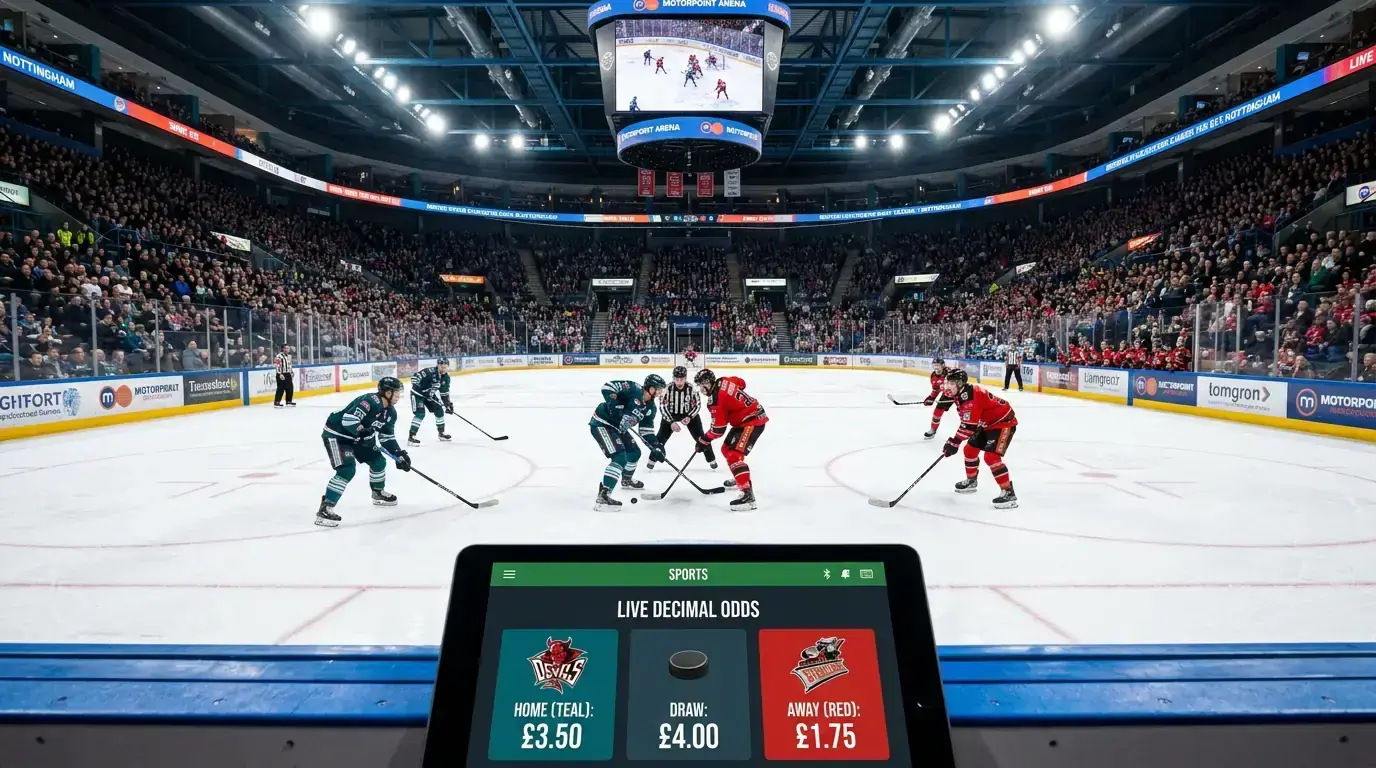

The home league hiding in plain sight
For years I’d fly through the NHL section of every betting app and skate straight past the EIHL without a second glance, like most British punters. Then one Saturday I actually went to a Cardiff Devils game, stood in a packed barn of nearly four thousand people losing their minds over a third-period winner, and realised I’d been ignoring the most bettable hockey league on my own doorstep.
The Elite Ice Hockey League — the EIHL, Britain’s top tier of professional ice hockey — is where UK punters have a genuine edge the NHL will never give them. You can watch these teams, learn their rhythms, see which sides travel badly and which rinks are fortresses, all in your own time zone. And the bookmakers price it lighter than the NHL, which means the lines are softer and the value easier to find for anyone willing to do the homework. This is the league where local knowledge actually pays.
The 2025-26 season ran ten teams through 270 matches, and the title race told you everything about how to bet the league: Belfast Giants took the regular-season crown for their eighth title, Nottingham Panthers lifted the Challenge Cup, and Cardiff Devils won the playoffs. Three different trophies, three different winners, all among the same cluster of heavyweights — and that pattern, a handful of strong clubs trading silverware while the rest scrap below them, is the key that unlocks EIHL betting. EIHL odds come in decimal, they reward the punter who knows the clubs, and they punish the one who treats Britain’s league like a poor man’s NHL.

What the EIHL actually is
If you’ve only ever known hockey through the NHL, the EIHL will surprise you — it’s faster, scrappier, and far more intimate than the polished North American product, and that texture matters when you’re pricing a bet. This isn’t a development league or a novelty. It’s a genuine professional competition with imports, rivalries, and rinks that get genuinely loud.
The league fielded ten teams across the 2025-26 campaign, playing a hefty 270-match schedule that drew a combined attendance of 1,321,128 at an average of 3,863 per game. That average crowd is the first number I want any EIHL bettor to absorb, because it’s not a sleepy backwater figure — it’s a packed, partisan environment that demonstrably shifts how teams perform at home. And those crowds are growing: the league average has climbed steadily from 3,148 in 2022-23 to 3,660 in 2024-25 and on to 3,863 in 2025-26, a rising tide that tells you the league is strengthening, not fading. Stronger attendances mean stronger home environments, and stronger home environments mean the home-ice edge you bet on is real and getting more reliable.

The competitive structure is worth understanding because it creates distinct betting markets. There’s the regular-season title, decided over the long league campaign; the Challenge Cup, a separate knockout-style competition; and the playoffs, the end-of-season tournament that crowns a champion in its own right. In 2025-26 those three went to Belfast, Nottingham and Cardiff respectively — proof that backing one team across all three trophies is a mug’s game. Each competition rewards different qualities, and the smart EIHL bettor prices them separately rather than assuming the best regular-season side sweeps everything.
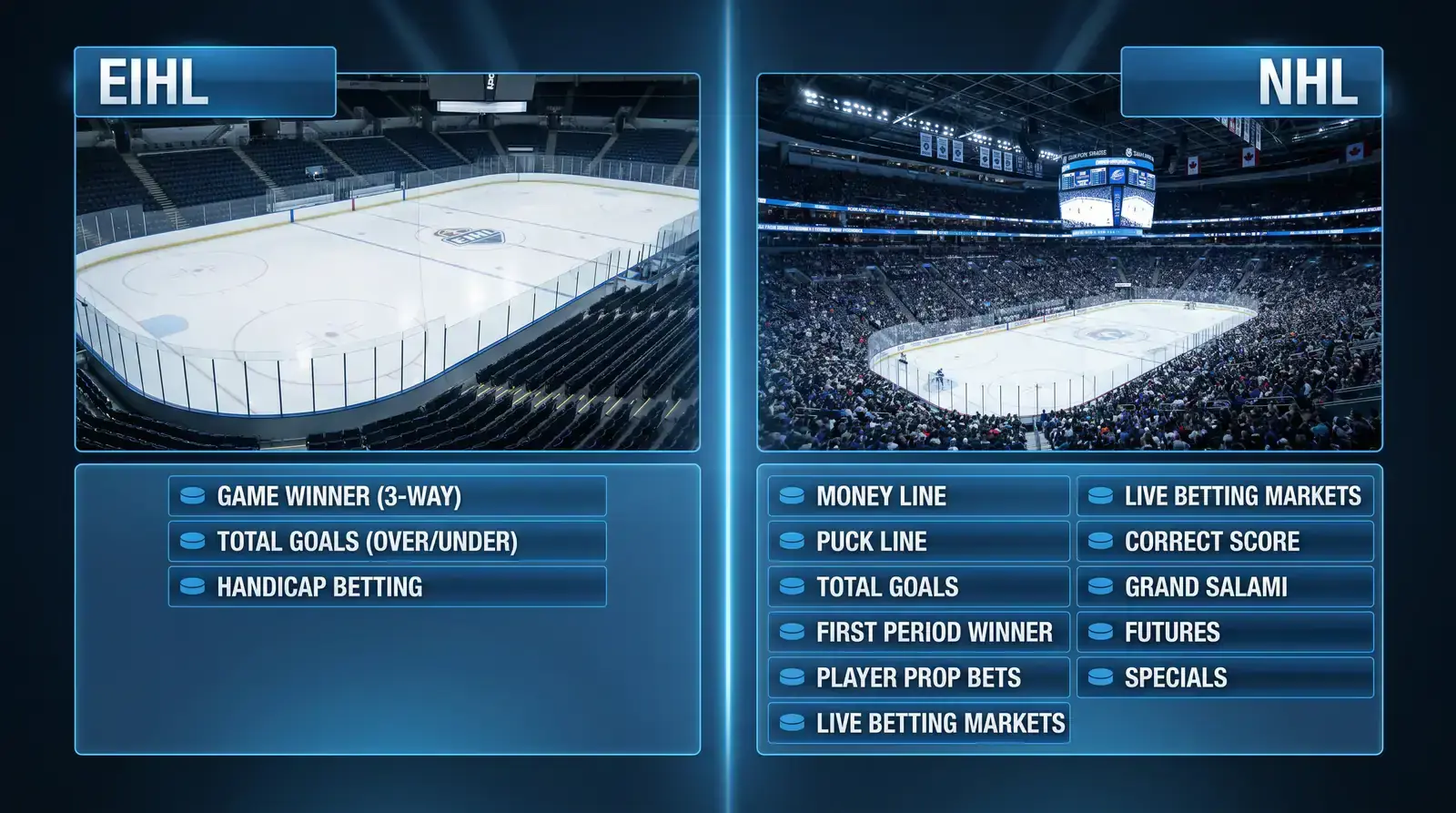
What you won’t find in the EIHL is the bottomless market depth of the NHL. Bookmakers offer the core lines — match winner, the handicap, totals, and outright markets on the trophies — but the exotic props and the dozens of in-play markets thin out considerably. That’s a feature, not a bug, for the value-hunter: fewer eyes and fewer markets mean the prices that do exist are less efficiently set, and a punter who genuinely knows the league can exploit a softness the NHL’s heavily-traded lines simply don’t offer.
Reading the championship outright odds
The first time I looked at an EIHL title market I assumed the favourite would be some runaway price like 1.50, the way a dominant NHL side might be. It isn’t, and understanding why is the whole art of betting the league’s outrights.
The EIHL’s title race is a genuine contest among a small group of heavyweights, and the prices reflect it. The perennial contenders — sides like Sheffield Steelers, Belfast Giants and Cardiff Devils — sit in a championship range of roughly decimal 3.50 to 5.00, meaning even the favourite is priced as no better than a one-in-three or one-in-four shot to lift the trophy. That spread tells you something important: the bookmaker doesn’t believe any single team is dominant enough to be a short-priced lock, because recent history keeps producing different winners across the three competitions. When Belfast can take the league, Nottingham the Challenge Cup and Cardiff the playoffs in the same season, no title favourite deserves a cramped price.

The practical upshot is that EIHL outrights reward patience and timing more than picking the “best” team. Because three or four sides are bunched in that 3.50 to 5.00 band, the value isn’t in spotting the strongest club — the market already knows who they are — but in catching a contender before their price shortens. Back a heavyweight early in the season at the longer end of that range and a strong start can see the same team trading much shorter by Christmas, leaving you holding a price the market no longer offers. The outright is as much a bet on timing as on talent.
One genuine word of caution on outrights, and it applies across every league. A title bet ties your stake up for months, and a decimal 4.00 that looks generous in October is dead money by March if your side fades. I treat outrights as a small, considered slice of my EIHL betting rather than the main event, precisely because the long lockup magnifies the cost of being wrong. The match markets turn over every week; the outright makes you wait an entire season to find out.
There’s a subtler skill in reading what the cluster of prices is actually telling you. When three or four sides sit within touching distance of each other at 3.50, 4.00 and 4.50, the market is effectively saying it can’t separate them — and that’s an admission, not a conviction. Compare that to a league where one team is a 1.80 favourite and the rest are 8.00 and out; there the market is confident, and confidence is hard to beat. The EIHL’s flat, bunched outright board is the opposite: a market hedging its bets because the league genuinely produces different champions across its three trophies. Every season that pattern holds, the bunched prices become more justified, and the edge moves away from “pick the winner” and toward “catch the right side at the right moment.” I keep a quiet eye on early-season form precisely because a heavyweight that wins its opening handful of games will see a 4.50 collapse toward 3.00 within weeks, and the punter who moved first banks the difference.
Why home ice matters more in the EIHL
Here’s a number that changed how I bet the EIHL entirely. The league’s top sides win between 60 and 65% of their home games, and at least one of them — Cardiff Devils — has posted home win-rates that comfortably clear 70% in their best seasons. In a sport this prone to upsets, that is an enormous, bankable edge, and it’s hiding in a league most UK punters never bet.
Home advantage in hockey is real everywhere, but in the EIHL it’s pronounced, and the attendance figures tell you why. Those average crowds of nearly four thousand, packed into compact British rinks, create an atmosphere that demonstrably lifts the home side and rattles visitors — and unlike the NHL, where teams crisscross a continent and home ice is partly about rest and travel, EIHL travel is short enough that the crowd effect dominates. The growing attendances from 3,148 up to 3,863 over recent seasons mean that home edge isn’t just persisting, it’s intensifying as the barns get fuller and louder. When you’re pricing an EIHL match, the venue is not a footnote. It’s one of the largest single factors in the result.
The betting implication is direct: home favourites are the backbone of EIHL value. The top sides’ match odds against mid-table opposition sit in the decimal 1.60 to 1.90 range, which implies a win chance somewhere between 53 and 63%. But if those same sides are actually winning 60 to 65% of their home games — and Cardiff sometimes north of 70% — then a chunk of those home prices are quietly too long. The market under-rates the home environment just often enough that a disciplined bettor backing strong home sides at the right price has a structural edge, not a hunch.
That said, I never back home ice blindly, and neither should you. The edge lives at the right price — a heavyweight at home against a weak visitor at 1.65 is a different bet from the same fixture priced at 1.40, even though both are “home favourites.” The skill is recognising when the market has properly accounted for the home effect and when it hasn’t, then betting only the latter. Home advantage is the EIHL’s most reliable angle, but reliability and value are not the same thing, and confusing them is how a good edge turns into a flat season.
Let me make the maths concrete, because this is where the angle either earns its keep or doesn’t. Say a top side is at home to mid-table opposition and priced at 1.75. One divided by 1.75 is an implied chance of about 57%. Now ask the honest question: is this a side that wins closer to 62 or 63% of its home games? If the answer is yes — and for the league’s heavyweights it usually is — then the price is offering you roughly a five-point edge on every bet of that type. Five points doesn’t sound like much, but repeated across a season of home favourites it’s the difference between a profit and a slow bleed. The trap is the same fixture at 1.50, implying 67%: now the market has overshot the true home win-rate, and the “obvious” home favourite is quietly a bad bet. Same team, same rink, opposite verdict — and only the implied-probability check tells them apart.

How EIHL markets differ from the NHL
Punters who jump between the two leagues without adjusting get burned, because the EIHL and NHL are not the same betting product wearing different jerseys. The core bets look identical — match winner, handicap, totals — but everything around them is different in ways that change how you should wager.
The most obvious difference is market depth and liquidity. The NHL is one of the most heavily-traded sports markets in the world, with razor-thin margins and dozens of props on every game; the EIHL, running its ten teams through a 270-game season, is a far quieter market with fewer bookmakers offering it and fewer markets per fixture. That quietness is the EIHL bettor’s edge — softer lines, less efficient pricing, more room for genuine knowledge to matter — but it also means you’ll sometimes struggle to find a price at all on the more obscure markets, and the handicap and totals lines can be set more crudely than the NHL’s finely-tuned numbers.
The second difference is the one no UK punter should overlook: you can actually follow the EIHL. The games are in your evening, not the small hours; you can attend matches, watch streams at a civilised time, and build the kind of granular feel for teams that’s almost impossible to develop for a 32-team North American league three thousand miles away. That accessibility is the single biggest reason I tell UK bettors to take the home league seriously — your information edge over the bookmaker is far larger here than it could ever be on the NHL, where the market has already digested every conceivable angle. If you want to see how the deeper, more liquid North American market behaves by contrast, the differences are worth studying in NHL odds for UK bettors.
Where the real value hides in EIHL prices
After several seasons of betting Britain’s league seriously, I’ve come to a conclusion that surprises people: the EIHL is more bettable than the NHL for a UK punter, precisely because it’s less popular. The edge isn’t in some secret system. It’s in the gap between what the market knows and what you can know.
The value clusters in three places. First, home favourites among the heavyweights, where the 60 to 65% home win-rates I keep returning to are often a shade better than the implied chance in the 1.60 to 1.90 prices. Second, the outright markets, where catching a 3.50 to 5.00 contender before a hot streak shortens their price is a timing play the NHL’s tighter outrights rarely offer. Third, the simple fact that fewer sharp bettors are working these markets, so a soft line stays soft longer than it would on a heavily-traded NHL game. None of these require inside information — just the willingness to watch the league and act before the market catches up.
I’d add a fourth, quieter source of value that comes only with watching: situational reads the market is too thin to price. The NHL has algorithms accounting for every back-to-back, every goalie rest day, every travel mile. The EIHL often doesn’t, because the betting volume doesn’t justify that level of modelling. So a side playing its third game in four nights, or a heavyweight visiting a rink where it historically struggles, may be priced almost as if those factors don’t exist. If you’ve actually followed the season — if you know which imports just arrived, which goalie is carrying a knock, which side travels badly to Belfast — you’re trading against a market that hasn’t done that homework. That asymmetry simply does not exist on the NHL, and it’s the strongest argument for a UK punter to make the home league their specialism rather than an afterthought.
What I’d warn against is treating the EIHL as a place to bet big because the value looks easy. Softer lines tempt overconfidence, and a league with ten teams and genuine week-to-week variance will humble anyone who mistakes an edge for a certainty. The push toward treating gambling harm as a public-health matter rather than a personal weakness has gathered real momentum in Britain, and one charity welcomed the shift directly, stating it was glad to “welcome this new era in which gambling harms are recognised alongside other public health issues and are funded through a statutory levy.” I keep that framing close: the EIHL’s value is real, but value is an argument for betting smarter, not bigger. Stake within limits you set in advance, treat every edge as an edge rather than a sure thing, and remember these markets are for adults aged 18 and over who can afford to lose what they put down. The home league rewards knowledge and patience — it does not reward the punter who confuses a soft line with a free lunch.