


Betting a North American sport from a British armchair
My first NHL bet went on at half past midnight, in pounds, on a price I’d had to convert from the American odds a US tipster had quoted me. By the time I’d worked out that “minus 150” meant a 1.67 decimal price, the line had already moved. That clumsy start taught me the central truth of betting the NHL from Britain: the league is American, but the way you bet it has to be entirely British.
The NHL is the deepest, most liquid ice hockey betting market on earth, and for a UK punter that’s both a gift and a warning. A gift because every conceivable market exists, from the match winner to the most obscure prop, all available on UK apps in pounds and in fractional or decimal odds. A warning because depth means efficiency — the lines are sharp, the margins thin, and the easy value that hides in a quiet league like the EIHL is far harder to find in a market this heavily traded. Betting the NHL well from the UK is less about secret edges and more about discipline: reading the markets accurately, timing your bets around the news, and adjusting to the practical realities of following a sport that mostly plays while you sleep.
This guide is about those British realities. How the core NHL markets work and where they’re priced, how Stanley Cup futures behave over a long season, what the time-zone gap means for when and how you bet, and why the lines move so violently in the hours before puck drop. The NHL rewards the UK bettor who treats it as a craft rather than a flutter — and the first part of that craft is knowing exactly what you’re betting on.

The core NHL markets and how they’re priced
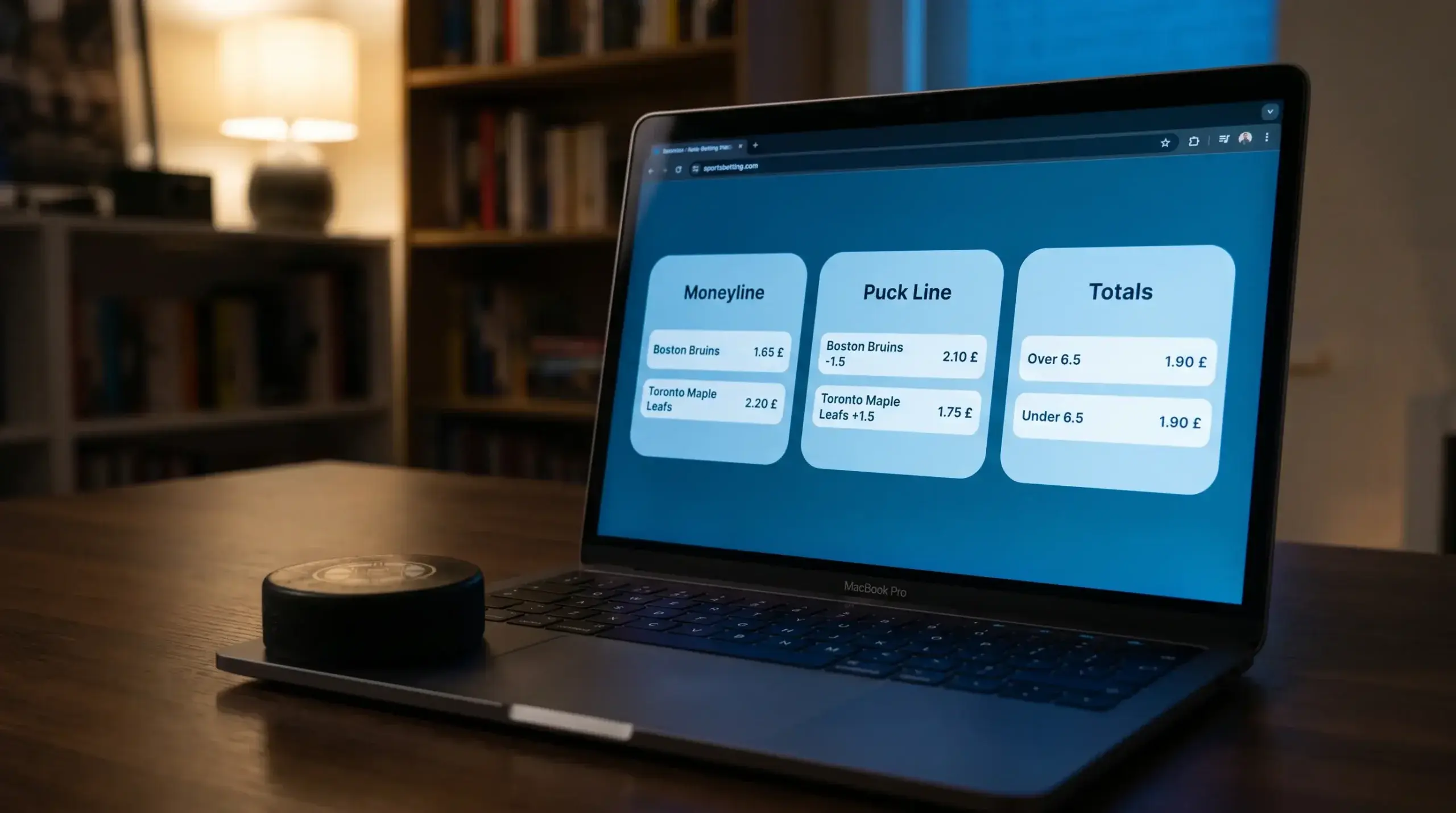
Walk into the NHL section of any UK betting app and the sheer number of markets can be paralysing. Strip it back, though, and almost everything you’ll ever want sits on three pillars, the same three that hold up hockey betting everywhere — the difference is how finely the NHL prices them.
The match winner, or moneyline, is the foundation: pick the side that wins, settled on the full result including overtime and the shootout on the standard two-way line. Then comes the handicap, the puck line, which in the NHL as everywhere is fixed at plus or minus 1.5 goals — the favourite must win by two or more to cover the minus 1.5, while the underdog can lose by one and still pay on the plus 1.5. The third pillar is totals, the over/under on combined goals, where the typical NHL line sits around 5.5 to 6.5 goals depending on the teams and goaltending. Those three markets cover the vast majority of sensible NHL betting, and mastering them matters far more than chasing exotic props.
What sets the NHL apart from a quieter league is how tightly these standard markets are priced. This is one of the most heavily-traded sports markets in the world, which means the moneyline, puck line and totals lines are set with real precision and corrected fast when they’re wrong. The margins are thin — good for the punter in the sense that you’re not bleeding overround on every bet, but punishing in the sense that genuine mispricing is rare and short-lived. You’re competing against a market that has already digested every angle, so your edge has to come from information or timing the market hasn’t fully absorbed yet, not from spotting a soft line that’s sat there all day.
The half-goal on the puck line deserves a quick note because it shapes how the three markets relate. Since hockey is low-scoring and so many games finish within a single goal, the puck line at 1.5 carries real risk on the favourite’s side and real safety on the underdog’s, which is why the prices swing so far from the moneyline on the same game. A team might be 1.50 to win outright but 2.40 to win by two on the puck line — and reading that gap correctly, knowing how often a given side actually wins comfortably versus scraping through, is where the three markets stop being separate bets and start being one connected picture of the game.
Beyond the three pillars, the NHL piles on the extras: period betting, team totals, alternate handicaps and puck lines at different numbers, and a sprawling range of player props on points, shots and goalscorers. The depth is genuinely impressive, but it’s also where casual bettors quietly leak money. The exotic markets carry fatter margins than the core lines precisely because they’re harder to price and easier to dress up as exciting, and the bookmaker’s edge tends to be largest exactly where the punter’s knowledge is thinnest. I’ll dabble in props when I have a specific read, but my standing advice is to win on the three core markets first and treat everything else as a sideshow until you’ve proven you can beat the simple stuff.
How Stanley Cup futures behave over a season
I once held a Stanley Cup future from October that looked brilliant in February and worthless by April, and the journey between those points taught me more about futures than any guide. A Stanley Cup outright isn’t a bet you place and forget — it’s a position you hold while its value drifts beneath you all season long.
The Stanley Cup future is an outright market: you back a team to win the championship, at a price set long before the playoffs, and that price moves constantly as the season unfolds. Early in the year the board is wide open, with contenders priced at generous decimal numbers and longshots out at enormous odds. As teams establish form, suffer injuries, or catch fire, their prices shorten or drift accordingly. The skill isn’t picking the eventual winner — nobody can do that reliably across eighty-two games and four playoff rounds — but understanding that the price you take is a snapshot of a constantly moving market, and timing your entry to catch a contender before their number collapses.
The integrity of that long market matters more than people think, because a futures bet held for months depends entirely on the games being played straight. The NHL’s commissioner has been pointed about this, arguing the league’s product is fundamentally sound, saying he has “real confidence in our game, the integrity of our game, and the integrity that our players and all of our personnel bring to the game.” For a futures bettor staking money on an outcome six months away, that integrity is the bedrock — you’re trusting that the season plays out on merit, and the league’s heavy scrutiny of its own competition is part of what makes a long-horizon bet viable at all.
My practical rule on Stanley Cup futures is to treat them as a small, early-season position rather than a season-long obsession. The value is best before the market has settled, when a genuine contender can still be had at a price that reflects uncertainty rather than form. Wait until they’re flying and you’ll get a cramped number; back them too early on nothing but reputation and you’ll watch the stake die through a bad autumn. A measured early bet on a side you genuinely rate, sized small because it’s locked up for months, is the futures play that’s served me best.
One trap I’d flag for newcomers to futures is the appeal of the longshot. A team at 50.00 to win the Cup looks like a lottery ticket worth a punt, and occasionally one comes in — but the maths is rarely as kind as it feels. Those long prices usually still carry a worse margin than the contenders, and the realistic chance of a 50.00 side actually winning four playoff rounds is slimmer than the price suggests once you account for it. I’m not against the occasional small, fun longshot, but I’d never confuse it with a value bet. The futures value, when it exists, sits with the genuine contenders caught at the right moment, not the romantic outsiders the long prices are designed to sell.

What the time-zone gap means for UK bettors
The single biggest practical difference between betting the NHL and betting your local league has nothing to do with odds and everything to do with the clock. Most NHL games start late evening or deep into the night by UK time, which reshapes how, when and whether you bet far more than any pricing quirk.
That timing gap has real consequences. Live betting an NHL game often means being awake at one or two in the morning, which is neither practical nor healthy as a regular habit. The pre-game markets are your friend here: because the lines are set and largely finalised in the hours before puck drop, a UK bettor can do their thinking at a civilised time, place considered pre-match bets in the evening, and simply not watch the game live. The discipline of betting before bed rather than chasing in-play action at 2am is, frankly, one of the healthier structures the time difference quietly imposes.
There’s a market-wide dimension to this too, and it’s worth understanding why the NHL is liquid enough to bet sensibly from Britain at all. The UK online betting market is enormous — average monthly active online accounts reached 13.5 million in the final quarter of the 2024-25 financial year — and that scale means UK bookmakers price the NHL deeply, in pounds, with full markets, despite the games playing through the British night. You’re never short of a market; you’re only ever short of a sensible hour to watch one. Build your NHL betting around pre-game decisions made in the evening and the time zone stops being an obstacle and becomes a useful constraint.
The flip side is that the late starts make the NHL a poor fit for the kind of all-evening live betting some punters enjoy with closer leagues. If in-play is your thing, the practical reality of NHL timing for a UK audience is a genuine limitation, and one worth being honest with yourself about before you build a betting routine around a sport that mostly happens after midnight.

Why NHL lines move before puck drop
The most useful skill I’ve developed betting the NHL from the UK is reading why a line has moved between when I first looked and when I’m ready to bet. In a market this sharp, the movement isn’t noise — it’s information, and learning to read it is worth more than any tip.
NHL lines move for two broad reasons: news and money. The single most powerful piece of news is the confirmation of the starting goaltender. Hockey is unique in how much one player — the goalie — shapes a result, and when a team confirms its starter, especially if a star netminder is rested or a backup is forced in, the moneyline, puck line and totals can all lurch in response. A confirmed elite starter shortens his team’s price and drops the total; a backup does the reverse. Roster news, injuries, and the grind of back-to-back fixtures all push lines the same way, and because the market is so liquid, it absorbs that news almost instantly.
The other driver is sharp money — large, informed bets that move the line as bookmakers adjust to balance their position. When a line shifts without obvious news, it’s often because serious money has landed on one side, and following or fading that movement is a genuine skill. The same late-game dynamics that decide bets matter here too: roughly a fifth to a quarter of games feature an empty-net goal, almost always padding the lead of the side already in front, and sharp bettors price that tendency into totals and puck lines in ways the casual punter never sees. Reading the move means asking whether it’s news-driven or money-driven, and whether the new price is now too short or has overcorrected into value.
For a UK bettor the timing lesson is concrete: because lines firm up in the hours before puck drop, the price you see in the afternoon is rarely the price at face-off. I’ve learned to identify the bets I like early but hold off until goalie confirmations land, because jumping in before the starters are announced is betting blind on the single biggest variable in the sport. Patience until the line has the real information baked in is, more often than not, the difference between a good price and a guess.

There’s a counterpoint worth holding in mind, though, because timing cuts both ways. Sometimes the value is in betting early, before the market has digested news you’ve spotted first. If you have a strong read that a key player is likely to be rested and the line hasn’t moved yet, waiting for confirmation hands the value to everyone else who reacts at the same moment. The genuinely sharp NHL bettor isn’t dogmatically early or late — they bet early when they’re ahead of the news and late when they need it. That judgement, knowing whether you hold information the market hasn’t yet, is the closest thing to a durable edge a UK punter can build on a market this efficient, and it only comes from following the league closely enough to know something before the price does.
Turning NHL knowledge into disciplined bets
For all its depth and glamour, the NHL is the hardest of the major hockey markets for a UK punter to beat, and pretending otherwise is the fastest route to a bad season. The market is sharp, the value is thin, and the league plays while you sleep — so the edge, such as it is, comes entirely from discipline rather than secret knowledge.
The British realities all point the same way. Bet in pounds, in the format you read most clearly, having converted any American odds you encounter so you actually know what you’re staking — getting fluent in fractional vs decimal odds is genuinely foundational here, because misreading a price is the most avoidable loss in betting. Build your wagering around pre-game decisions made at a sensible hour rather than half-asleep in-play punts. Wait for goalie confirmations before committing on the biggest variable in the sport. Treat Stanley Cup futures as small, early positions, not season-long fixations. None of these is glamorous, but all of them are the actual craft of betting a sharp market from three thousand miles away.
The discipline extends to the part that matters most. A liquid, always-on market like the NHL, available at any hour on a phone, is precisely the kind of environment where betting can quietly escalate, and Britain’s gambling rules have tightened in recognition of exactly that risk. The shift toward treating gambling harm as a public-health issue rather than a private failing is one I take seriously as the backdrop to every bet, and the league’s own commissioner is right to guard the integrity that makes the sport worth betting in the first place. Set your stakes before you look at the price, keep them flat while you’re learning the market, and never let a late-night NHL slate become a reason to chase. These markets are for adults aged 18 and over, and the bettor who treats the NHL as a craft to be practised soberly will always outlast the one who treats it as a way to stay up gambling until dawn.