

Why the same price wears two faces
The first time a mate showed me his betting slip and asked why he’d “only” won a fiver on a £6 stake, I knew exactly what had gone wrong. He’d backed a heavy favourite at 5/6, watched it win, and expected the screen to hand him eleven quid back. He got it — £6 returned plus £5 profit, eleven in total — but in his head the “5” meant five times his money. That single misread is the most common, most expensive habit I see in nine years of reading hockey lines, and it almost always traces back to one thing: not understanding that a price can be written two completely different ways.
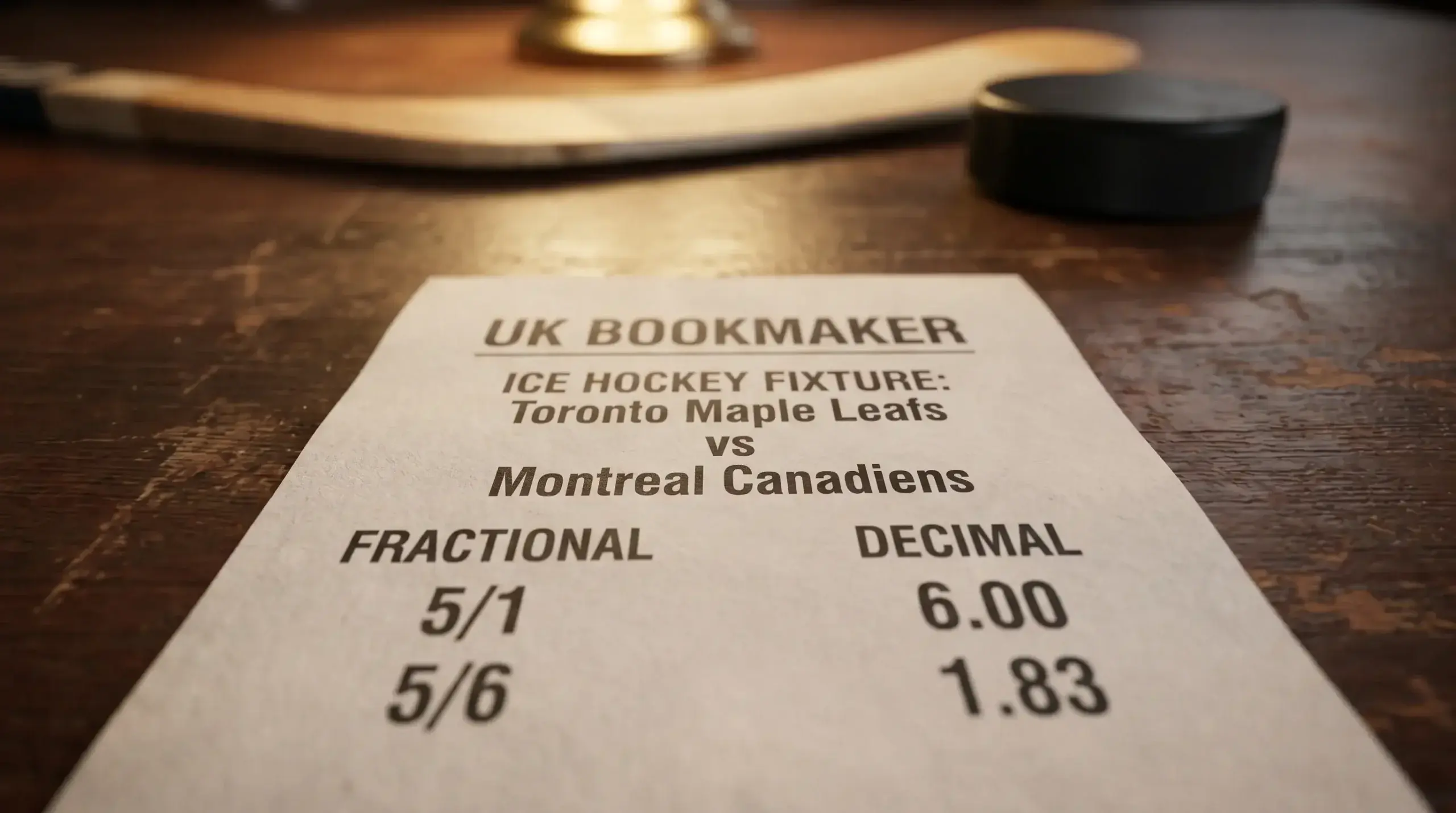
Here is the uncomfortable truth that this whole guide exists to fix. The exact same ice hockey price can appear as 5/1 on one screen and 6.00 on another, and a punter who treats those as different bets will leave money on the table or, worse, talk themselves into a wager they’ve badly misjudged. Decimal format simply shows the total return on a one-unit stake, so 3.0 means £2 profit plus your £1 back, and that single-number simplicity is exactly why most newcomers find decimal easier to read than dividing a fraction in their head mid-match.
British bookmakers have spent decades printing odds as fractions because that is the language of the racecourse, and ice hockey inherited it by default. But online, with NHL and EIHL fixtures sitting side by side on a single coupon, you will flip between fractional and decimal constantly. The skill you need is not memorising one format. It is being able to convert instantly, calculate your real return, and spot when one screen is quietly offering a worse price than another. By the end of this you will read 5/6 and 6.00 the way you read a clock — without thinking.
How fractional odds actually work
Ask ten British punters what 5/1 means and nine will tell you “five to one.” Ask them what they actually win on a tenner and a surprising number stall. That gap — between reciting the phrase and doing the arithmetic — is where the format earns its reputation for being fiddly. So let me strip it back to the one rule that never fails you.
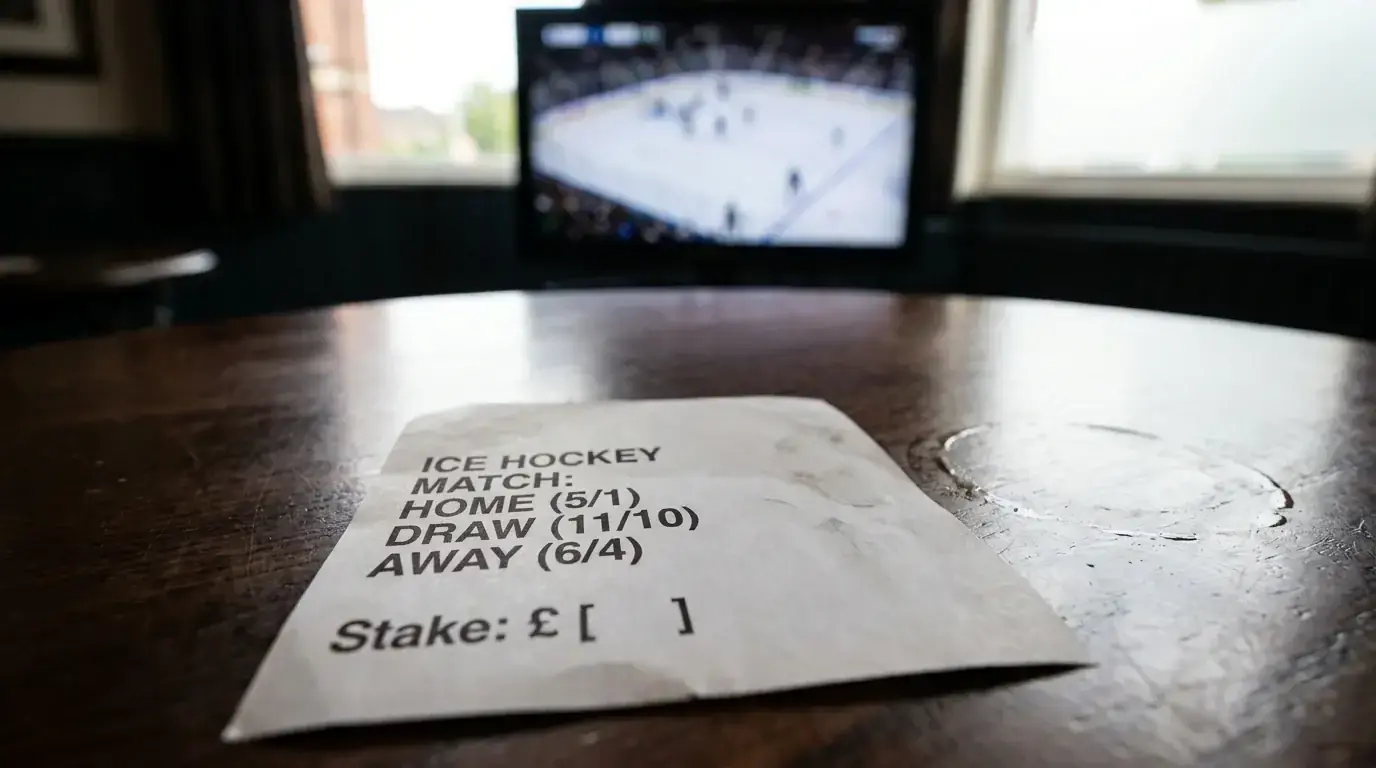
A fraction is profit over stake. The left number is what you win, the right number is what you must risk to win it. Back something at 5/1 and a winning £1 stake hands you back £5 in profit plus the £1 you put down, leaving £6 in your account. That is the textbook odds-against price: the first number is bigger than the second, and the bet pays you more than you risked. The longer the odds drift — a fancied EIHL outsider going from 4/1 out to 9/1 — the more those numbers spread apart, and the bigger the implied reward for the bigger implied risk.
Then there is the format’s quiet trap, the odds-on price, where the bookmaker has decided a selection is so likely that they will pay you less than you stake. A 5/6 favourite is the classic. Put £6 on at 5/6 and a win returns £5 profit plus your £6 back — eleven pounds in the hand for a six-pound risk. Notice the fraction is now smaller than one: five over six. That inversion is the bit that catches people, because it looks like a typo to anyone used to seeing the big number first. It isn’t. It is simply the bookmaker telling you “this is more likely than not, and you’ll be paid accordingly.”
What makes fractional odds genuinely awkward in a hockey context is that hockey markets move fast and trade in messy numbers. You will see 8/13, 11/10, 21/20, 6/4. None of those is intuitive at a glance, and you cannot price an accumulator across three NHL games while juggling 8/13 by 11/10 by 6/5 in your head on the sofa. The fraction is fine for a single, settled price. It becomes a liability the moment you need to combine selections or compare two bookmakers quickly, which is precisely the moment decimal earns its keep.
One habit I drilled into myself early and recommend to anyone serious: read every fraction as a question — “how much profit per pound of stake?” — rather than as a slogan. 5/1 is five pounds profit per pound. 5/6 is roughly eighty-three pence profit per pound. 11/10 is £1.10 profit per pound. Frame it that way and the odds-on prices stop looking strange, because you stop expecting the first number to mean “multiply my money.”

How decimal odds make life easier
I switched my own staking spreadsheet to decimal years ago and never looked back, and the reason is almost embarrassingly simple. Decimal tells you the total return on a single unit, full stop. There is no profit-versus-stake mental step, no inverting for odds-on prices, no fraction to simplify. The number is the whole story.
Decimal shows the total return on a one-unit stake, so an odds value of 3.0 returns £3 on a £1 stake — that’s £2 profit plus your original £1 back — and that all-in-one figure is exactly why beginners reach for decimal first. Multiply your stake by the decimal and you have your return. A £20 bet at 2.50 returns £50. A £20 bet at 1.91 returns £38.20. There is nothing to add back, nothing to convert, no room for the “I only won a fiver” confusion that sent me down this whole rabbit hole.
The format’s real superpower shows up the instant you build anything more complex than a single. Combining selections becomes plain multiplication: three legs at 2.00, 1.80 and 2.50 give you a combined decimal of nine, so a tenner returns ninety quid. Try doing that with evens, 4/5 and 6/4 in your head and you will either reach for a calculator or get it wrong. Decimal also makes the odds-on versus odds-against distinction trivial: anything above 2.00 is odds-against, anything below 2.00 is odds-on, and 2.00 itself is evens. One glance, no thought.
There is a subtle reading skill that decimal teaches almost for free, and it matters enormously for value. Because the number includes your stake, decimal maps cleanly onto probability — a price of 4.00 implies a one-in-four chance, 2.00 implies a coin flip, 1.25 implies an 80% chance. Fractional odds hide that relationship behind arithmetic; decimal puts it on the surface. When you are scanning a row of EIHL match prices trying to find a mispriced home side, that instant probability read is worth more than any tipster’s hunch.

I want to dwell on that last point because it’s where decimal quietly changes how you bet rather than just how you read. Most casual punters look at a price and ask “how much could I win?” The number nudges you toward a better question: “how often does this need to happen for the bet to make sense?” A 2.50 line needs the result to land more than 40% of the time to be worth backing. A 1.50 line needs it more than two-thirds of the time. Once you start reading decimals as break-even frequencies rather than payout multipliers, you’ve crossed the line from punter to something closer to a trader — and you’ve done it without learning a single new formula, just by reading the format the way it wants to be read.
Converting one format to the other
Here’s a scenario I run into most weekends. I’ve found a price I like on one site shown as 11/8, and I want to check whether the bookmaker next door at 2.40 is offering me better. To compare them, I have to drag both into the same language — and the language I use is always decimal, because converting into it takes a single addition.
The formula is the only piece of arithmetic in this whole guide worth committing to memory: divide the fraction, then add one. Decimal equals the top number divided by the bottom number, plus 1.00. So 5/1 becomes 5 ÷ 1 = 5, plus one, equals 6.00. The 5/6 odds-on favourite becomes 5 ÷ 6 = 0.833, plus one, equals 1.83. And my 11/8 becomes 11 ÷ 8 = 1.375, plus one, equals 2.375 — which rounds to 2.38, fractionally worse than the 2.40 next door. That tiny edge, four-tenths of a percent, is exactly the kind of margin that compounds over a season if you always take the better line.
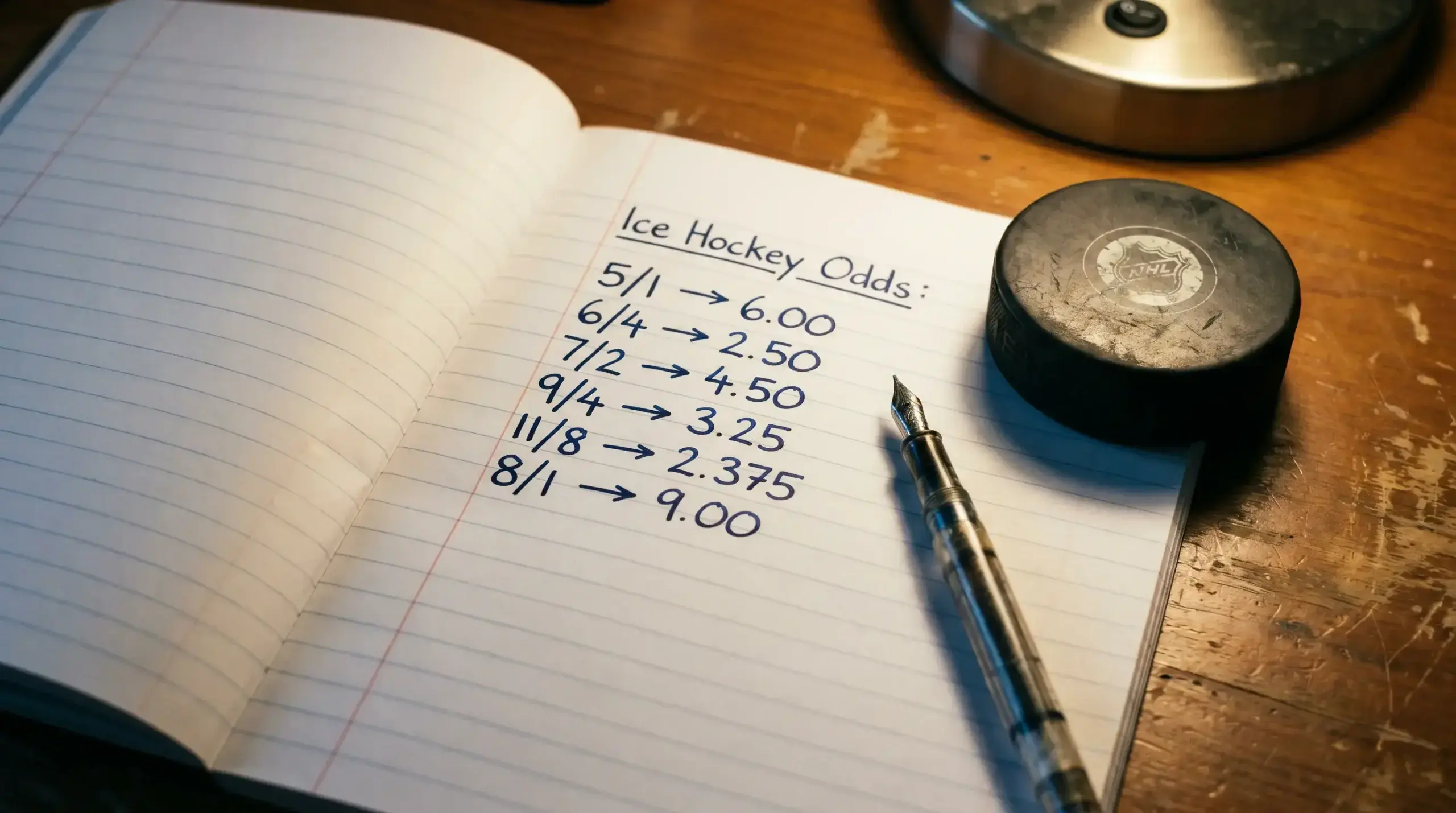
Let me walk a few more so the pattern sticks. Evens, written 1/1, is 1 ÷ 1 = 1, plus one, equals 2.00 — the dividing line between odds-on and odds-against. A 6/4 puck-line favourite is 6 ÷ 4 = 1.5, plus one, equals 2.50. A short 4/9 outright on a dominant EIHL side is 4 ÷ 9 = 0.444, plus one, equals 1.44. Once you have done five or six of these, the common prices start living in your memory as pairs, and you stop reaching for the formula at all.
Going the other way — decimal back to fractional — is rarer but worth knowing for when a friend quotes you a price the old-fashioned way. Subtract one from the decimal, then express what’s left as a fraction. A decimal of 2.50 minus one is 1.5, which is 3/2 or, in betting shorthand, 6/4. A decimal of 1.40 minus one is 0.40, which tidies to 2/5. You will rarely need this online, but it keeps you bilingual, and being bilingual in odds is the whole point.
A word on the awkward fractions, because they trip up even experienced bettors. Prices like 4/7, 8/13 and 10/11 look hostile, but the divide-and-add-one rule treats them exactly the same as any other. 4/7 is 4 ÷ 7 = 0.571, plus one, equals 1.57. 8/13 is 8 ÷ 13 = 0.615, plus one, equals 1.62. 10/11 is 10 ÷ 11 = 0.909, plus one, equals 1.91 — the standard “two sides of a coin” hockey price you’ll see on countless evenly matched games. The ugliness is entirely cosmetic. The arithmetic doesn’t care how unusual the fraction looks, and neither should you once the formula is automatic. I keep a tiny mental table of the dozen prices I see most in hockey, and for anything off-piste the calculator on my phone closes the gap in two taps. There’s no prize for doing it in your head.
The single most valuable thing the conversion habit gives you is the ability to turn any price into an implied probability, because that is how you judge whether a bet is actually worth making. Implied probability is just one divided by the decimal, expressed as a percentage. A price of 2.00 implies 50%, 4.00 implies 25%, 1.50 implies 66.7%. If your own read of a game says the home team wins more often than the price implies, you have found value. If it doesn’t, you’ve found a trap dressed up as a tempting number — and that distinction is what separates a disciplined punter from a hopeful one. The same probability lens underpins the bookmaker’s margin, where prices stop adding up to a tidy hundred percent.
Why a bookmaker’s odds never add up to 100%
Add up the implied probabilities of every outcome in a two-way hockey market and you’ll get a number bigger than 100. The first time you do this it feels like you’ve caught the bookmaker in an arithmetic mistake. You haven’t. You’ve just discovered the overround — the margin baked into every price, sometimes called the vig or the juice, and it’s the reason the house stays in business.
Picture a clean coin-flip game where each side genuinely has a 50% chance. Fair odds would be 2.00 each, and your implied probabilities would total exactly 100%. No bookmaker offers that. Instead they shade both sides to, say, 1.91 and 1.91. Run the numbers: one divided by 1.91 is 52.4%, and two of those total 104.8%. That extra 4.8% is the overround, the bookmaker’s cut, and it exists whether the favourite wins or the outsider does. The same online betting boom that pushed UK online gross gambling yield up 13.1% to £7.8 billion in the year to March 2025 runs entirely on these slim, relentless margins repeated across millions of bets.

The practical lesson is that the margin is not fixed. Different bookmakers set different overrounds, and a tighter market — one totalling 103% rather than 107% — is mathematically returning more to punters over time. This is why I never bet a price without a glance at one or two rivals. On a single bet the difference is pennies. Across a season of hockey wagering it is the gap between a manageable loss and a painful one. Reading two formats fluently is what lets you make that comparison in seconds rather than talking yourself out of it.
There is a responsible-gambling dimension here too, and it’s one the UK industry has been forced to confront. The people who push hardest for fairer, more transparent markets have long argued that gambling harm is a public health issue, not a personal failing. As GambleAware’s leadership has put it, they have “long advocated for a statutory, Government-led approach to addressing gambling harm, recognising it is a serious public health issue which can affect millions of people each year.” Understanding the margin is part of betting with your eyes open — knowing the maths is tilted against you is exactly why staking discipline matters more than any single winning night.
Which format should a beginner actually use
If you’re starting out and someone tells you “real punters use fractions,” ignore them. That’s tradition talking, not strategy. I’ve watched too many newcomers lose confidence wrestling with 8/13 when the same price as 1.62 would have told them everything in a heartbeat.

My advice is unambiguous: set your account to decimal and learn fractions as a translation skill. Decimal is simply easier for the things a beginner does most — working out a return, comparing two prices, judging whether a number represents a fair chance. The single-figure clarity that makes decimal the natural choice for newcomers is the same clarity that helps you avoid the “I only won a fiver” mistake, because the return is staring at you before you’ve even confirmed the bet.
That said, do not stay monolingual. British bookmakers, racing coverage, and plenty of hockey pundits will throw fractions at you, and you need to recognise 11/10 as 2.10 without breaking stride. Treat fractional as a second language you read fluently but rarely write. The conversion formula — divide and add one — is the only bridge you need between them, and after a few weeks of betting you’ll cross it automatically.
One last thing I tell everyone who asks. The format you choose changes nothing about whether a bet is good. 5/1 and 6.00 are the identical wager with identical value; the only thing that changes is how clearly you can see what you’re doing. Pick the format that lets you think straight, learn to read the other, and spend your actual effort on the part that matters — finding prices that are too generous for the real chance of the result.
Betting within your limits while you learn
I’ll be blunt about something the slick odds-comparison sites tend to skate over. Getting fluent in formats makes you a sharper bettor, and a sharper bettor is not automatically a safer one. The clearer the maths becomes, the easier it is to convince yourself the next bet is the smart one, and that’s exactly the moment to have your limits already set rather than improvised in the heat of a match.
The UK has tightened the guardrails considerably. Since 9 April 2025 there’s been a £5 stake cap on online slots for all adults, and from 21 May 2025 a £2 cap for players aged 18 to 24 — a recognition that younger bettors need extra protection while they build the habits that keep gambling enjoyable. Those limits don’t apply directly to a hockey moneyline, but the thinking behind them should shape how you bet on anything: decide your stake before you look at the price, not after.
The charity sector welcomed those changes precisely because they target harm before it takes root, with one joint statement backing “the Government’s plans for the new statutory levy on the gambling industry, alongside the introduction of lower online stake limits.” Treat learning to read odds the same way you’d treat learning to drive — the skill is worth having, but the discipline around it is what keeps you out of trouble. Set a budget you can lose without flinching, keep your stakes flat while you’re learning, and never chase a misread bet with a bigger one. Once formats are second nature, the natural next subject is the puck line, where the handicap of puck line betting adds a goal margin on top of the price you’ve just learned to read.
