


The skill that outlasts every tip
If you gave me a choice between a bettor with brilliant judgement and reckless staking, and one with average judgement and disciplined staking, I would back the second to still be betting in a year. The first will have blown up after a bad run; the second will have ridden it out. Bankroll management is the unglamorous skill that decides who survives, and almost nobody new to betting wants to hear it, because it is about restraint rather than winners. With around 47% of British adults having gambled in the past four weeks, the ones who last are disproportionately the ones who learned this first.

Your bankroll is the pot of money you have set aside for betting, separate from the money you live on. Bankroll management is the set of rules governing how much of that pot you risk on any single bet, and it is the foundation everything else is built on.
Setting a unit size
The central idea is the betting unit, a fixed fraction of your bankroll that you stake on a standard bet, rather than betting random amounts based on how confident or excited you feel. A common approach is to make one unit a small percentage of the total pot, so that no single bet can do serious damage and no losing run can wipe you out before your edge has time to show.
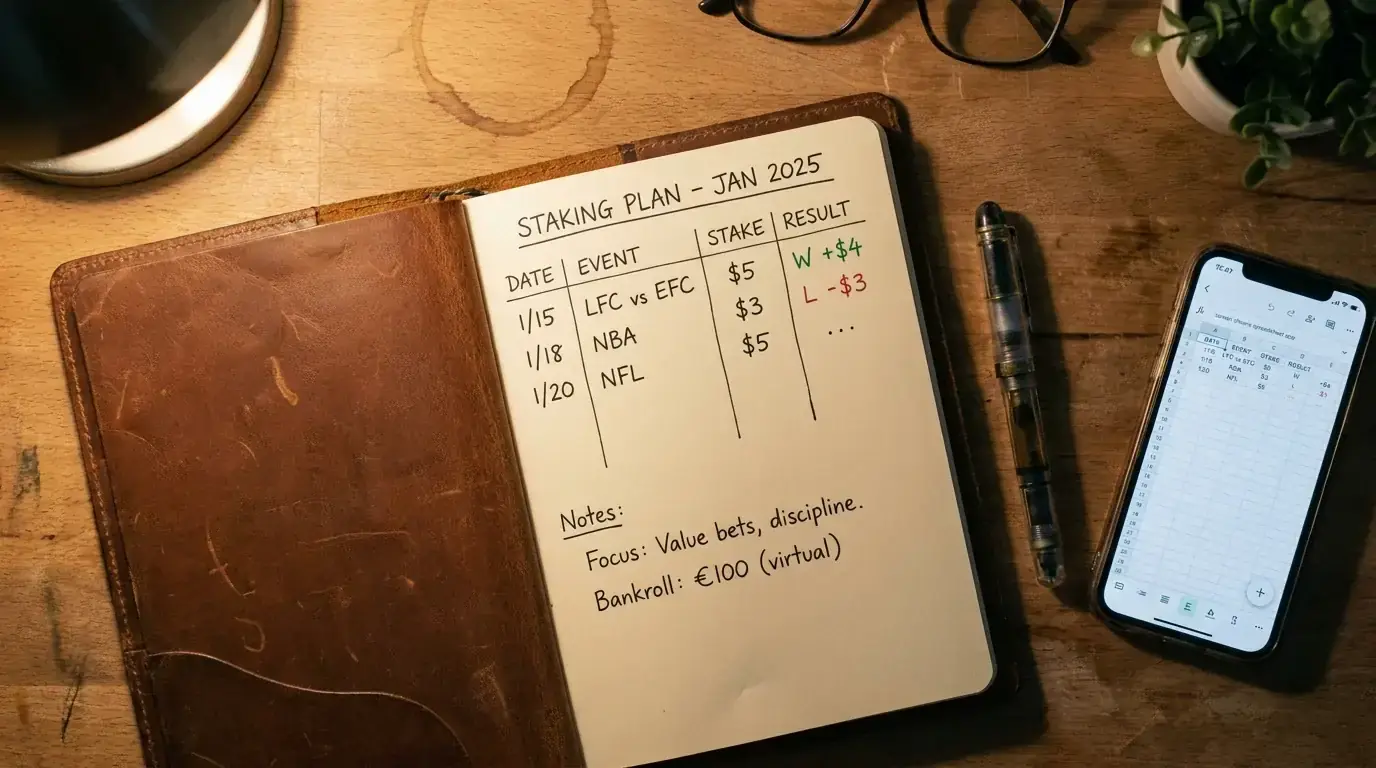
The arithmetic of why this works is worth sitting with. Because a decimal price shows the total return on a one-unit stake, a one-unit bet at 2.00 wins one unit and a loss costs one unit, so a flat-staking bettor knows exactly what is at risk every time. Keep the unit small relative to the bankroll and even a long losing streak, which every bettor endures, leaves you with plenty of pot to continue. Make the unit large and a single bad week can end your season, however good your judgement.
I set my unit as a small, fixed slice of the bankroll and recalculate it occasionally as the pot grows or shrinks, but never in the heat of a session. The discipline is in the fixedness: the unit is decided in advance, with a clear head, not adjusted on the fly because a bet feels like a sure thing. There are no sure things, and the bettors who stake as if there were are the ones who do not last.
Flat versus variable staking
There are two broad schools of staking, and the choice between them matters. Flat staking means betting the same one unit on every selection regardless of confidence, and it is the approach I recommend to anyone still finding their feet. Its virtue is that it removes emotion from the stake entirely; you cannot talk yourself into a reckless bet because every bet is the same size, and the result of any single game cannot derail you.

Variable staking adjusts the stake to your confidence, betting more units on selections you rate highly and fewer on marginal ones. In principle this lets a skilled bettor press their genuine edges, and the EIHL’s strong home favourites, winning sixty to sixty-five percent of their home games at prices around 1.60 to 1.90, are the kind of higher-confidence spot where a variable staker might lean in. The danger is that it requires honest, accurate self-assessment of your edge, and most bettors badly overrate their confidence, turning variable staking into an excuse to bet big on hunches.
My view, after years of both, is that flat staking is the safer default and variable staking a tool for bettors who have proven, through records, that their confidence actually correlates with results. Until you have that evidence, betting the same unit every time protects you from your own optimism, which is the most expensive thing a bettor owns.
Protecting the bankroll
The hardest part of bankroll management is not the maths; it is the temptation to abandon it during a losing run. Chasing losses, raising stakes to win back what you have dropped, is the single most destructive habit in betting, and it is precisely what good bankroll management exists to prevent. The unit stays the same whether you are up or down, because the moment you increase it to recover losses, you have stopped betting and started gambling against your own discipline.

This is where the UK’s protective tools meet personal practice. The 2025 reforms introduced stake limits on online slots and a statutory levy to fund harm prevention, and the support charity GambleAware welcomed the clarity this brought, with chief executive Zoe Osmond noting, “Following years of uncertainty, the levy will provide clarity of funding for the gambling harms sector, support long-term planning and prevent duplication of work.” The personal equivalent of that clarity is a deposit limit set on your own account, which caps how much of your bankroll can ever be at risk and removes the in-the-moment decision to chase. Setting one is the practical backbone of protecting your pot.
I treat my deposit limit as the hard boundary the unit system lives inside. The unit governs how much I risk per bet; the deposit limit governs how much can ever reach the account in the first place. Together they make a bad run survivable rather than catastrophic. For the staking discipline that complements this when building multi-leg bets, where stakes can balloon fast, see my starter guide to ice hockey betting.
Betting to still be here next season
The mindset that bankroll management instils is the long view, and it is the opposite of how most people approach betting. You are not trying to win big this weekend; you are trying to keep enough of your pot intact that your judgement has time to pay off over a season and beyond. Set a unit, stake it flat until your records earn you the right to vary, never chase a loss, and anchor it all to a deposit limit. Do that and a bad run is a dip rather than a disaster, and you are still betting, and learning, when the reckless bettor has long since busted out.